
This article is more than 2 years old
Alice’s story: “I hope children with CF will be inspired to follow their own dreams”
Alice had made her decisions with advice from her CF team. Everyone with CF is different, and what might be possible for one person with CF may not be advised for someone else. Always speak with your CF team before making any changes to your medication. They can also support and advise you on travel plans.
 What was your diagnosis like?
I was diagnosed with cystic fibrosis at seven years old. I don’t remember much other than coughing up green gunk at night, but from what my mum told me, I had tonsillitis and chest infections over and over again. I was taken back and forth to the GP, and my mum was told there was nothing wrong with me. They kept sending me home with antibiotics, and I eventually had my tonsils out, but I kept having pneumonia anyway.
I was eventually put in hospital, and I was in a pretty bad way. A junior doctor came and saw me, and there was some mention of my skin tasting salty when my mum kissed me on the forehead. She suggested doing a sweat test as she’d been studying CF as part of her junior doctor’s course.
They ordered the test, and I was diagnosed with CF. Within 24 hours of being on the right drugs, I improved massively and became a happy, healthy child. My parents were in shock.
We have no history of CF in our family at all. I have a sister, and though she doesn’t have CF, she does carry the gene.
What was it like growing up with CF?
 All through my childhood and teenage years, I was very against physiotherapy; I absolutely hated it. I never really did my medications, and I would lie through my teeth at doctors’ appointments. I’d say whatever I needed to say to get out of having IVs and to get out of the hospital.
Once I turned 18, I became in charge of picking up my prescriptions and my treatments, but I never did. Eventually, my consultant pulled up my records from my GP of all the times I’d actually picked up my prescriptions and completely caught me out. It was in a room full of doctors, nurses, dietitians and my boyfriend at the time. I was mortified. He gave me one of those chats where he basically told me if I don’t take this seriously, in a few years, I’m not going to be able to go travelling or do all of the things I enjoy. So, I started to take it seriously from then.
The first six months were really ropey, but since then, my body has gotten used to it, and it’s the best thing that’s ever happened to me. It’s made my daily life easier and I don’t really cough up mucus at all unless I’m ill.
Alice
Are you able to take Kaftrio? What’s that been like?
I’ve been on Kaftrio since December 2020, so just over two years. I didn’t really have a purge or anything in the beginning, and the first few months were really, really tough. I had a full-body rash for weeks and really bad acne. My heart would be pounding at night time, and I'd just sort of think, 'What's the point of anything?' which is so out of character for me. I also started twitching in my eyebrow, and I still get little twitches now under my eye and we still don’t know why. I didn’t feel like my concerns were taken seriously in clinic, which was frustrating.
After taking Kaftrio for two months, I still had a rash, so I was taken off it for a month, and my dose was halved. I was given an orange pill in the morning and then a blue one at night. I did that for 6-9 months because most of the side effects had eased, and I was able to sleep. I wasn’t having drastic thoughts or headaches, and the twitching wasn’t as intense. I was slowly reintroduced to a full dose, which I still take now.
The first six months were really ropey, but since then, my body has gotten used to it, and it’s the best thing that’s ever happened to me. It’s made my daily life easier and I don’t really cough up mucus at all unless I’m ill. Last year, I had COVID-19 twice and the flu and I ended up in hospital. It’s obviously not a cure, but my day-to-day life is a lot better, and my lung function has really increased.
Tell us about your love for travelling!
 A couple of years ago was a really bad year for me with my health due to COVID-19, the flu, and being in hospital a lot, which made me really anxious, so I decided to take 2024 off and go travelling.
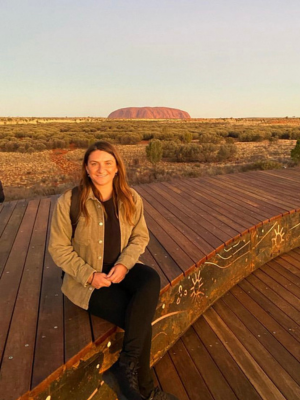
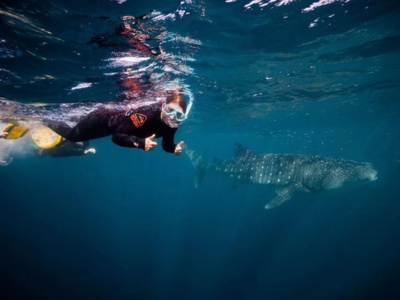
I left home in January, and I was away for eight months. I did a three-month trip through Asia, where I took a four-day scuba diving course (after lengthy discussions with my CF consultant) and then came to Australia to work. I travelled the West Coast and the Outback.
The logistics of the medications can be hard to get right, and I took my nebuliser with me, my hypertonic saline, my vitamins, my enzymes and my Kaftrio. I used exercise as my physio, so I was constantly walking and being active.
Before I came to Australia, my consultant contacted the CF centre here so that if there was a problem, they’d have my notes.
Do you have any top tips for someone with CF who is considering going travelling?
 Try to be as organised and honest as you can. When I first started travelling at 22, I would say whatever I needed to say to go, and I used to go with no medicine, which is obviously not the smartest thing. When I first came to Australia at 22, I worked on a banana farm and caught an infection and ended up having to get IVs. I would recommend being smart and discussing your treatment with your CF team so that when you travel, you're able to make the most out of your trip whilst keeping safe and healthy.
I have a lung function machine that helps me monitor my health myself, and when I was away I had virtual clinics every three months, which my CF team have set up, so that’s been really useful.
Can you tell us what it was like to have IVs abroad?
It was a scary time and definitely more challenging as my main support system of family and friends weren’t with me – I was in Australia and so you couldn’t get further from the UK.
I initially went to a very small hospital in a town called Tully where I was working and I communicated with my CF team in the UK who advised the doctors there what treatment I needed. The hospital didn’t have the necessary equipment or access to the medication and so I was transported two hours away to the nearest specialist hospital.
It was definitely the most challenging IVs I’ve had, but thankfully within the first week I was much better and continued on my travels through Australia. Whenever I go travelling, I always check where the nearest respiratory or CF centres are to ensure there is a back-up if I was to be unwell while away.
Can you tell us about your new children's book, Little Tourist: A Cystic Fibrosis Adventure, and what inspired it?
The book is about a character with cystic fibrosis who wants to travel the world. It’s based on my life and love for travel and the challenges I’ve faced either preparing to go, or when I’ve been abroad. I always dreamed of being able to scuba dive or keep up with my friends when hiking, but in my younger years this was a challenge.
As I’ve got older and understand my disease more, I’ve found a good balance of exercising and completing my treatments to look after myself. With that came the ability to train and improve my walking and even being well enough to be approved for scuba diving. I loved the experience so much it inspired the idea to create a children’s book about going on a trip around the world. The book is something I would have liked to have had as a child growing up with cystic fibrosis.
What do you hope children with CF feel when reading the book?
I hope they will feel inspired to keep themselves well and know they aren’t alone with their treatments. CF can be isolating as we cannot mix with other people with CF in person. I wanted to create a character they could relate to, that doesn’t just teach them about what their illness is or why it’s important to complete treatments. But also shows that someone with CF can still hope to do what others can if you work hard. I hope they will be inspired to follow their own dreams.
If you are thinking of going travelling or considering a risky sport or activity, please speak to your CF team for advice.
Talk to your CF Team if you are experiencing physical or mental side effects on Kaftrio - they can offer support and advice and discuss your treatment plan with you. You can also report side effects via the Yellow Card Scheme. Please discuss with your CF team before changing any treatment or medications. Our Responses to Kaftrio factsheet provides more information, or reach out to our Helpline at 0300 373 1000 or 020 3795 2184, Monday–Friday 10am–4pm, or on [email protected].
Cystic fibrosis (CF) is a genetic condition which causes sticky mucus to build up in the lungs and digestive system. It affects almost 11,000 people in the UK. One in 25 of us carries the faulty gene that causes it, usually without knowing.
Since 1964, we've supported people with cystic fibrosis to live longer, healthier lives - and we won’t stop until everyone can live without limits imposed by CF.
If you’re struggling with any aspect of cystic fibrosis, we’re here to help. Contact our Helpline for support, a listening ear or just someone to talk to.

Sign up to our newsletter
Get the latest news on what the Trust and its supporters are doing straight to your inbox