
Types of CF clinical trial

You might come across terms for different types of clinical trial such as ‘controlled trials’ and ‘observational studies’. The type of trial depends on what the study aims to find out. You might also hear about different phases of clinical trial.
-
Controlled trials
Most clinical trials for new treatments are ‘controlled trials’. This means the new treatment is compared to a ‘control’, which can be a standard treatment or no treatment (a ‘placebo’). A placebo can be disguised to look like a real treatment, but it won’t have any real effects.
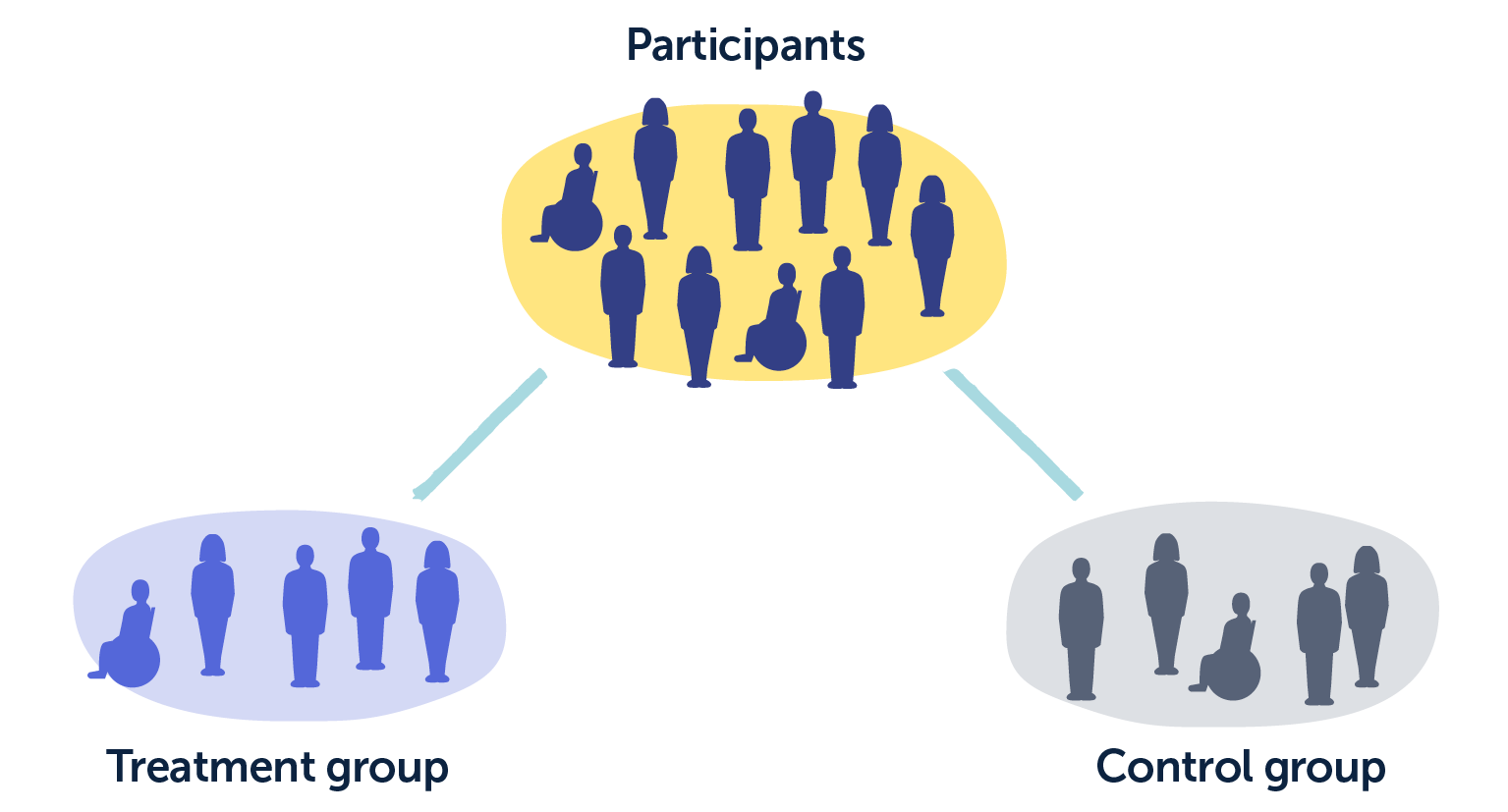
The people taking part (‘participants’) are usually put into different groups at random. You may hear these trials referred to as randomised controlled trials (RCTs).
There will always be at least one treatment group that take the new treatment and at least one control group. This helps the trial team prove whether a treatment works or not with more certainty.
Blind and double blind trials
In a controlled trial, sometimes the participants won’t know which group they are in. This type of trial is called a blind trial. Sometimes both the trial team and the participants don’t know which group everyone is in. This is called a ‘double-blind’ trial.
Open label trials
Unlike a blind trial, in an open label trial the researchers and the trial participants know they are taking the trial medication.
-
Observational studies
Some research studies are called ‘observational’ studies. In these studies, there is no intervention, but certain health measures are observed and recorded over a period of time. It may collect new data or use data that has already been collected. You may be asked to consent for your data to be accessed, to complete questionnaires, keep a diary or go into hospital for additional monitoring.
Real-world evidence studies
Real-world evidence (RWE) studies are a type of observational study that look at certain usages or effects of a treatment by collecting data in real-world settings.
For example, they might monitor clinical data of a person who is taking a medication as part of their standard care, rather than as part of a clinical trial. This data may be collected from a range of sources, such as health records or registries like the UK CF Registry.
Real-world evidence studies can help us understand the effects of a treatment in a bigger and more diverse group of people than a clinical trial. They can be important to help support regulatory decisions to approve or extend access to a treatment through the NHS or another healthcare provider.
Natural history studies
You might also hear of ‘natural history studies’. A natural history study is a type of observational study. These monitor a group of people over time to see whether demographic, genetic, environmental and other factors affect the development of CF or certain outcomes.
-
Genetic therapy trials
Genetic therapies are a new type of treatment to be used in clinical trials for CF. You might have different questions about these trials. Read our FAQs on genetic therapy clinical trials to find out more.
You might also be interested in
Phases of trial
Clinical trials go through different steps or ‘phases’. Find out what's involved in each phase.
About clinical trials
Find out more about CF clinical trials, how they work, and the latest news and developments.
Taking part in clinical trials
Find out more about what's involved in clinical trials and if taking part is right for you.