Employment stories

People within the CF community work in a variety of roles which range from retail to the boardroom. With the right support, the vast majority of careers are open to adults with cystic fibrosis. If you are considering your future career, check out our employment stories below to help discover the career path you wish to follow.
If you would like some support in pursuing your career goals, why not book in a session with our Careers Adviser, Gina, by completing our request for support form.
-
Izzie - Journalist and Content producer
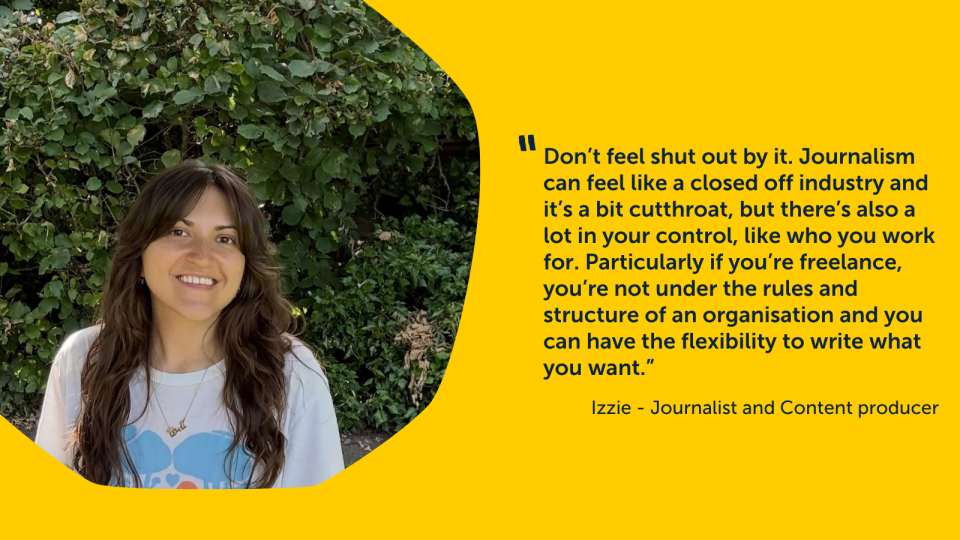
We spoke to Izzie about growing up without a dream job in mind, working in journalism, and the freedom of freelance. Izzie now works as a Content Producer at Diabetes UK and continues to work as a freelance journalist.
Education
Izzie was in hospital a lot as a child, and as a result, missed a lot of school. She explained that she wasn’t really aware of the barriers that it might have to her education: “As I got older, my dad told me that my teachers wrote me off. They thought I was never going to achieve anything because I missed too much school. They wouldn’t really help me to catch up on what I missed or anything. My family could help to an extent, but they weren’t trained in education and the school just thought there was no hope.”
“I missed so much school because of my health, so going to secondary school I always felt so flustered all the time. I was in hospital quite a lot and I'd get pancreatitis flares ups very regularly. So, I was trying to catch up with schoolwork while feeling really unwell. And even if I wasn't in hospital, I was missing one or two days of school every week.”
Because of this, Izzie never had a dream job in mind and wasn’t able to plan for the future. She said “I never thought about my future or a career because I didn't think it would like happen for me. I just did what I could. I basically taught myself everything for GCSEs but I still managed to get good grades. I then did A-levels and then I think at that point everyone else I knew was going to university so I guess I thought I had to.”
Choosing a career
Izzie ended up studying geography but never had a career in mind when studying.
“I realised at university that geography wasn’t for me anymore. I liked it at school, but it wasn’t the right path for me. I was in my third year of university and I started thinking about what I did like. I realised I really do like writing, and at the time I’d started a blog for writing about my life with CF. I was writing about my experience of navigating school and university. It was more of a creative outlet for me. I’m sure if many people read it, but it was fun to do.”
There were also opportunities to develop her writing skills within university. Izzie said “I looked at societies at university and saw there was an online magazine and student radio. I joined both of those when I was in my final year and loved it so much. I realised this is what I wanted to do.”
Finding opportunities after university
Izzie said, “I enjoyed talking about health and disability in my writing and had already started doing that.” Her friend then saw an opportunity for an internship at The Guardian for people with disabilities.
Izzie got the internship and that started off her career in writing and later led to freelance opportunities. She said, “it was amazing, and exactly what I wanted to be doing, but it was hard too because I had to go into the office and it was quite tiring for me.”
Izzie started freelancing and shortly after, the pandemic came along and changed the way everyone was working. She explained, “everything moved online and there were more opportunities that I wouldn’t have had otherwise.”
In 2021, Izzie completed an NCTJ in journalism, which again, because of the pandemic, was online. She said, “I couldn’t have done this in-person in London. I managed to get work at various places like the Financial Times and CNN, so that was amazing.”
However, after the pandemic, many places returned to needing people to come into the office again. “I couldn’t do those jobs anymore. It shut me out of the industry. I had to rethink what I do and why I do it. Then I saw a job at Cystic Fibrosis Trust for a Content Lead role.”
Working in charity
Th job at Cystic Fibrosis Trust came at the right time for Izzie. She said: “I had the right experience and had done a lot of video content, podcasting and writing through my journalism work. It was a maternity cover role, so having a year to do that was amazing. And working for a charity meant I was supported in a way I wasn’t before.”
In charity work, Izzie found an understanding of her condition that she hadn’t experienced before. She now works as a content producer at Diabetes UK three days a week and continues doing freelance writing as well.
“In other jobs, there was never really an understanding when I had time off for being sick. They’d put a lot of pressure on you and there was the expectation to work beyond your hours, work evenings and weekends, that sort of thing. But working for the Trust, and now working at Diabetes UK, there’s no expectation of doing extra work. It means I can do the job without putting my health at risk.”
Izzie’s advice
If you want to get in writing, Izzie said one of the most important things is being able to demonstrate how you write, whether that be on a Substack or a blog, or somewhere else.
She explained, “They want to know if you can write. It’s also about nailing your pitch. If you’re pitching a story to an editor, think about why you’re the right person to write it, and what kind of take you can have.”
She went on, “Don’t feel shut out by it. Journalism can feel like a closed off industry and it’s a bit cutthroat, but there’s also a lot in your control, like who you work for. Particularly if you’re freelance, you’re not under the rules and structure of an organisation and you can have the flexibility to write what you want.”
Journalism can be off-putting to some because of the personal nature of writing, and because of the fear of rejection. Izzie said, “Having confidence in yourself is important. I remember when I started, even though I’d written a few articles, I’d send pitches off and I’d feel so insecure and really anxious about it. And I didn’t really need to. Rejection is really normal. In any job, you’re going to face rejection, and it’s not personal.
“If you’re a writer, you don’t always have to write about yourself or your own experiences if you don’t want to. There can also be a bit of pressure to share things that you’re not ready to, especially in journalism where some people are looking to get the juiciest story or clickbait. You can say no.”
“Don’t feel bad about self-advocating. You need a job for money to live, but no job is worth putting your health at risk. And no company should be making you feel like you have to do that.”
-
Mark - Solicitor and Partner
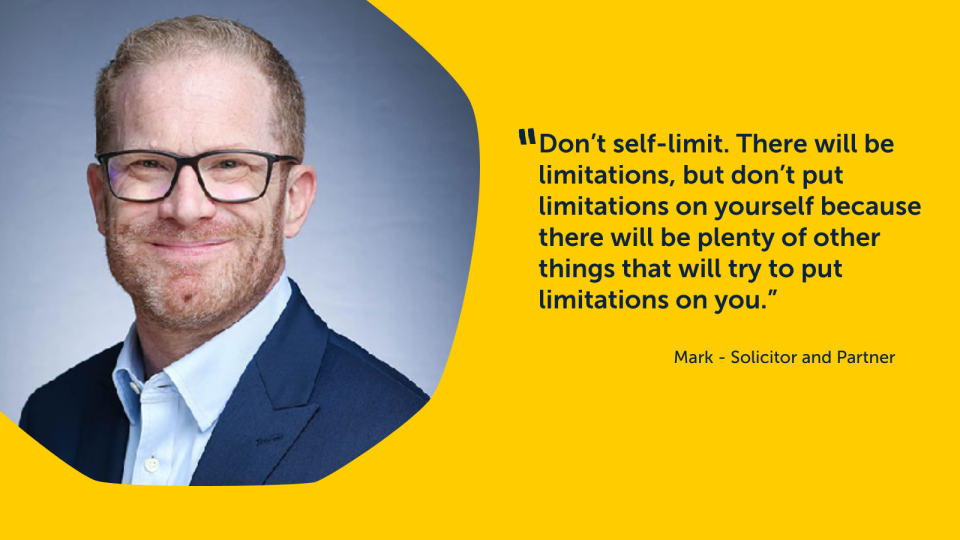
Mark Blois is a Founding Partner of the Education Team at Browne Jacobson LLP. He has been named in the 'Disability Power 100', an annual list recognising the 100 most influential disabled people in the UK on two occasions, in two categories: 'Education, Public & Third Sector' (2021) and 'Politics & the Law' (2023). Most recently, Mark was recognised on the Enable Role Model List 2025, which highlights 50 business leaders worldwide who are role models using their personal experiences of disability, neurodiversity or mental health to advance inclusion in the workplace.
Education
“There were various complexities and complications around having a condition like CF in the 1970s – I think it was a very different experience to what it would be today.”
Mark found that uncertainty about his health and future life made it hard for him to decide what he wanted to do next, and what was possible for him to achieve.
He explained, “I did my A Levels without any idea what sort of career I might have. I think part of that was being made aware that I had a very serious medical condition and my predicted life expectancy wasn’t deep into adulthood. My parents still encouraged me to be ambitious about what I might be able to achieve, but there was also a huge amount of uncertainty about the future and whether I would be well enough to even study at higher education, let alone do a job. So I think that’s why I didn’t have any clear vision of what I wanted to do.”
He ended up studying a History and Philosophy degree, which he found interesting, but wasn’t vocational and didn’t help him to decide what to do next. He described leaving university as “like treading water”, until he decided to study law.
“I decided that law as a career ticked a lot of boxes for me and and notwithstanding that it was against all expectations of something I could have dreamed of doing.”
Because he decided quite late, he didn’t have a training contract, and so after completing two years’ of further study, he found himself with another spare year where he went to study a Masters’ degree in Law, before starting work. He then joined the firm he’s still at now, 30 years later.
Choosing an area of law
“I always knew corporate law wasn’t going to work for me because of the nature of the business – there are often unpredictable hours, that sort of thing. I needed more structure. I’d done work relating to the education sector very early on in my career and I really enjoyed it. So I followed my nose a bit.”
His firm let him lead the way in the area of education, and it started to build momentum. By the mid-2000s, Mark had been able to build a team and lead it up until 2024, when he decided to hand it over to someone else and get a “a fresh pair of eyes”. The firm is now a leader in the education space, with a turnover of about £20m a year.
He went on: “I also wanted more balance in my life and to be able to make the most of the improvements in health I’ve had since taking Kaftrio.”
You can read more about Mark’s experience of Kaftrio here.
Health
“I wasn’t in a senior role from the outset, and the beginning of my career was the time when my health was most challenging. In fact, almost immediately after I began studying law is when my health began to decline. I think that was just CF catching up to me.
“I was 23 when I had my first IVs, which is quite late, but then I suddenly starting needing them four or five times a year. That was just about manageable as a student, but far more challenging in the workplace.”
Mark explained that, being the ‘90s, very few people had a good level of knowledge about CF, and were unlikely to have met anyone with the condition. “So even fewer people knew how to effectively support and manage someone with CF to get the best out of them. It was very challenging initially.”
He went on: “I was very secretive about it. It wasn’t a reflection of the firm, I just felt like the profession was so competitive that declaring a potential weakness was not a smart thing to do. So I shared it on a need-to-know basis. I tried to make my IVs as planned as I could at least try and appear like I was on top of things. I was often exhausted and went to bed very, very early. Most Saturdays, I’d be in bed by 2pm just to keep the show on the road.”
Mark even started putting a plan in place to teach law after a few years, because he wasn’t sure if he would be able to keep working as a lawyer long term. He went on to say that “when things go wrong, health-wise, I can feel like I am letting people down. They don’t make me feel that way, it’s just me, I take the job very seriously.”
Becoming a leader
“I worked my way up to becoming a partner and that’s when I got the opportunity to inform and educate, and support others living with conditions like CF, or who have other challenges that I had insight to and could help with. I think I saw that as a responsibility. Obviously, the flip side of that is that the more senior you get, the more responsibility you get, and the more people rely on you.”
Mark puts his success down to good luck, as well as a huge amount of determination and attitude. He acknowledges that his career hasn’t necessarily been the best choice for his health. “I made a decision I was prepared to make, where I sacrificed some optimality in health and treatment because the psychological benefits of the job, the sense of purpose will offset it.”
Advice for others
Mark said: “Don’t self-limit. There will be limitations, but don’t put limitations on yourself because there will be plenty of other things that will try to put limitations on you.”
He went on to say, “When I was younger, I was cutting my cloth according to what my doctors were telling me and what my parents’ expectations were. And that weighed very heavily on me. I think the right way to do it is ask yourself what would you want to be? What will give you purpose? What will get you out of bed most days? And then layer on top the practical side, rather than the other way around.”
For those looking to work in law, he explained, “it’s a bit like being a doctor. There are hundreds of different fields and career experiences available. You can work for the private sector, you can work for the public sector, you can advise businesses, you can advise hospitals, schools - it's a huge range of experiences. So, you need to find the experience that is right for you.”
He also had advice around whether to be open about your condition at work, something his opinion has changed over time.
“Sharing information about your medical condition is an intensely personal thing, and it’s your decision. My advice now is to own it, explain why it’s a positive, in terms of your character and the mindset that comes with having to manage something like CF.
“In law, you have to try and stand out and that is a way of distinguishing yourself. Obviously, there are downsides too, but there is a danger in thinking the only way to succeed is swimming in the same lane as everyone else – and it’s a really crowded swim lane.
“Obviously, everything is down to personal preference and the state of an individual’s health, but in some circumstances, it can be a very powerful thing. It can be very affirming too, to own your identity and say, this is me.”
For those looking to work in law, but unsure whether they have the time, resources, or health to commit to the length of study, Mark had further advice: “There are other areas you can work in within law firms. You’ve got marketing, human resources, finance, all sorts. They’re running the business, but don’t necessarily need the training that lawyers need. You can still make a brilliant contribution and be respected for your area of expertise.”
-
Kyla - Deputy Head of Financial Control
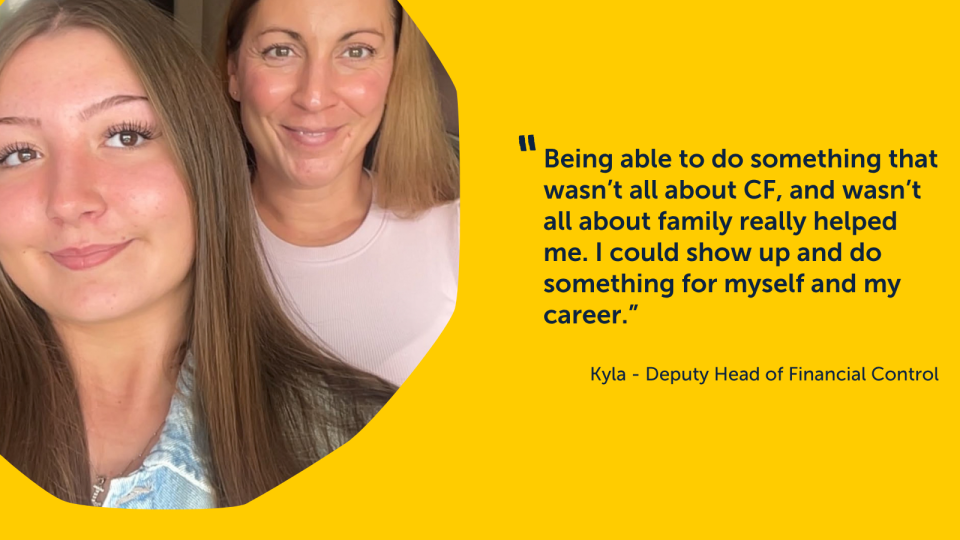
Kyla is a mum of four daughters – her eldest is 18 and has CF. She works as the Deputy Head of Financial Control at the Department for Environment, Food and Rural Affairs (DEFRA). She is a career civil servant, and has worked in four government departments, completing education up to A Level, and then undertaking two apprenticeships in finance qualifications while working. She is working towards becoming a Chartered Accountant.
Starting working life
“I did my GCSEs, went to college and started university, studying Law and French, but this only lasted a term because I met James, and we knew early on we wanted to build our lives together.” Not wanting to do a long distance relationship, Kyla came back to stay and changed direction, doing some smaller jobs, until landing her first “proper” job in Inland Revenue, which is now HMRC.
“This was back when they had local offices, and when they announced these were shutting, I went to the Treasury and got a job there in the Accounts Department.”
There, Kyla started studying for an Accounting qualification, but before long she became pregnant with her eldest child, Jazlyn.
“I was trying to study, but it was not happening. I ended up having to tell work that I was pregnant, and it was awkward because I hadn’t been there long, but they took it really well, which was good.”
Becoming a parent to a child with CF
Kyla decided she wasn’t going to carry on studying until after having her baby, but it wasn’t as straightforward as she hoped as Jazlyn was born with Cystic Fibrosis.
“We didn’t know beforehand that she had Cystic Fibrosis, we didn’t know that it was in the family and we didn’t know we were carriers. So at the six-week heel prick test, when we found out, we were devastated. Obviously all those years ago, the outlook wasn’t as bright as it is now, and it felt like the future was taken away from us.”
Kyla didn’t know what to do and whether she could return to work fulltime as her partner worked offshore a month on a month off. They decided that he was going to leave his job and get something local, so he could be there to help.
“I was thinking: how can I go back to work with all this responsibility. They tell you that you need to do physio three times a day, you’ve got to make sure they’re fed well and given all their medications, and all the other things that come with being a parent.”
But Kyla also wanted to keep her career. “I emailed my manager explaining what had happened. I said: my daughter’s been diagnosed with CF, so I’m not going to be able to come back full time. Will there be any flexibility? My manager was brilliant about it and gave me the hours I needed.”
Kyla went back to work 10 hours a week, roughly a day and a half, and then had three more babies. She was on maternity leave with her last child when a managerial position came up at work. But they needed her to come back full-time.
“I kept thinking, what should I do? I really wanted to do it and I knew this was going to be my last baby, so I needed to give it a try. My partner had his own business and could be a bit more flexible and I decided I was going to try it.” She put her youngest in nursery and drove into work, commuting an hour each way. “I lasted, six months maybe, then I said, I can’t do this and went back to my old job.”
Eventually, another opportunity came around, with fewer hours, and Kyla was able to take this instead, and also picked up her studies again, signing up to an apprenticeship.
Working from home
“A day before we went into lockdown, I went into the office and said I couldn’t be there anymore, it wasn’t safe for Jazlyn. They were very understanding. I set up a camping table in my bedroom and that was that. But the day after, everyone was doing the same thing anyway so it didn’t feel as bad.”
Kyla’s exams were cancelled but she continued doing her coursework at home, looking after four children and shielding. “That was a nightmare. We haven’t got a massive house, so I think we had one child camping out in the bathroom during lessons!”
When she was able to, she finished her exams and the apprenticeship. She was ready to take the next step in her career and started looking for other jobs in the civil service. After moving around different departments and trying things out temporarily, Kyla was successful in getting a permanent promotion at DEFRA.
“One big change was that I was working from home. I increased my hours to fulltime, and they were really good at factoring in the fact I’ve got four children and I’ve got a lot of caring responsibilities. So I do a nine day fortnight.”
Kyla realised in order to progress further with her career, she’d have to become a qualified chartered accountant, which saw her signing up for her second apprenticeship.
“I have six exams left out of 16 in total. So it’s been long, but hopefully by this time next year, I will be fully qualified. It’s been a lot of work.”
What advice would you give to other parents of children with CF?
“I think there’s something in keeping your options open, and try to keep a foot in the door in your career if you can, even if it’s just 10 hours a week like I was doing,”
“Being able to do something that wasn’t all about CF, and wasn’t all about family really helped me. I could show up and do something for myself and my career.”
She goes on to describe how much things have changed for her in a short space of time. “It’s not always going to be how it is now. Things will change and they might improve as your child grows. We know with CF there can be massive dips, there will be setbacks, but eventually, they’ll be grown and you’ll want something for yourself. And it’s so worth it, to work on something for yourself.”
Kyla also knows that organisation is key. “When the kids were younger, they used to go to bed early most nights, just so I could even have half an hour to myself.” She also found flexible working key. “Being able to start late if you’ve got to go into the school or finish earlier to pick them up, that flexibility has been really helpful for me.”
Finally, she says that being open and honest with your manager worked best for her. She said, “don’t bottle it up, don’t try and hide the fact you’ve got these caring responsibilities. Be open about the challenges you’re facing because your manager might not always be fully aware, and hopefully they can be more flexible and accommodating.”
-
Andrew - Operations Director
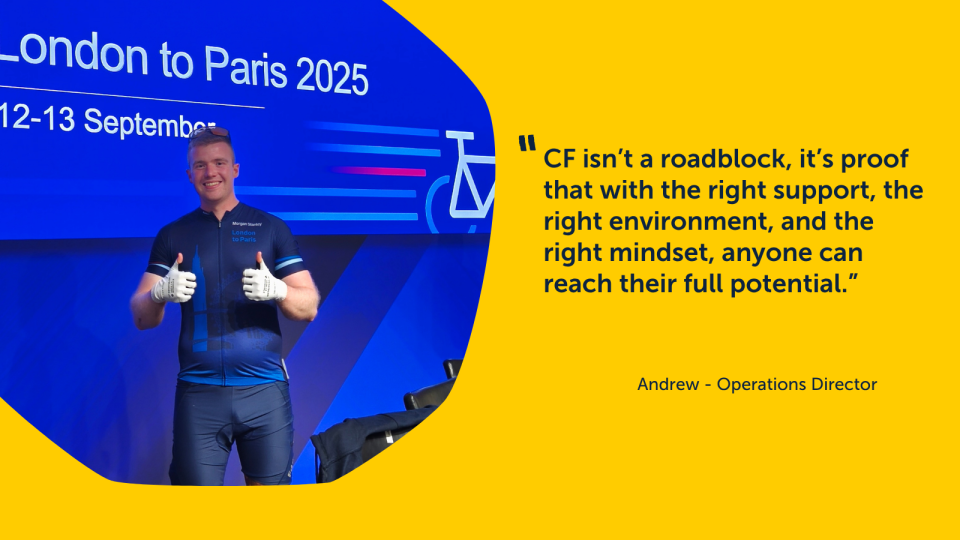
Andrew is an Operations Director at Morgan Stanley and studied Chemistry and Chemical Engineering at the University of Strathclyde. He also completed the London to Paris cycle ride – you can read more about his experience here.
Finding a career
“School was very challenging for me. I was in and out of hospital during Primary School quite a lot and that was hard. Classmates didn’t really know what was going on but would send me get well soon cards and letters.”
During high school, Andrew tended to enjoy scientific subjects like chemistry and maths and was also very sporty and enjoyed PE.
“Following that scientific route from high school, I studied chemistry and chemical engineering at the University of Strathclyde. My degree had a split curriculum, but I didn’t really enjoy chemical engineering at uni. It’s not as if I couldn’t do it, but I was thinking: do I want to do this for the rest of my life?”
Andrew decided to explore his options and ended up attending a Scottish graduate fair. There, they had various representatives from different sectors like transport, manufacturing, and Andrew found himself drawn to the finance sector, realising he didn’t necessarily need a finance degree.
“I felt comfortable speaking in front of people, so skills like presenting, communication, networking are transferrable and things that I really enhanced during my degree.”
Andrew spoke to Morgan Stanley at the career fair, and after researching the firm and its values, applied for their grad scheme. He was offered a role in their Operations division and started only a few weeks after his final Uni exam.
Working life
When describing his role he shared, “essentially, what operations does within Morgan Stanley is ensure the bank operates on a day-to-day basis. I work in the Global Bank Services (GBS) Team and in its simplest form, we open, close and maintain the cash and securities bank account population that the firm uses to operate across markets globally.”
After starting modulators, Andrew found that his health started to improve, he wasn’t in hospital as much and felt a lot more confident. He explained “I’ve found myself opening up a lot more because my health is more stable and I’m a lot more confident. I didn’t feel like I was lagging behind people as much anymore.”
When filling out his onboarding document, Andrew felt more confident putting his CF down, as his health had been stable. Despite that, he still needed to make sure people understood his CF. He said “in the worst-case scenario, I might need a couple of weeks off work for IV antibiotics or a hospital admission. But people don’t know that. When you think of a disability, you think of something that can be seen. CF, you can’t see. So, the biggest challenge is making sure people understand my CF.”
Andrew says that though he is more confident now, that hasn’t always been the case. “Initially, that was a challenge, and I was almost trying to hide it. If I was having a coughing fit, I would try and hide it by going to the toilet, or going out for a walk so people didn't know.”
“But I think being open and transparent has massively helped. Since I've told the team, I feel so much more comfortable now to speak up if I were to experience a flare up and say ‘it’s my CF’, and so it's not a burden on me. It's a weight lifted off the shoulders and everyone's fine with it and is so supportive.”
Andrew stresses that having flexibility and support has been key to his success in the workplace. “my manager fully supports me if I need time off for general routine check-ups or additional ad hoc appointments, I can just have the time I need. I don’t need to hide anything.”
What’s your advice for someone looking to get into finance?
Andrew explains that though he’s not worked anywhere else, “one of the biggest positives at my workplace is we have a good culture. The people are amazing across the office, and we have loads of initiatives to keep in touch and get involved to support each other via campus opportunities, committees and societies.”
He also says the diversity of people who work at Morgan Stanley is great and shows that you don’t just need one degree to go into the specific field. “We’ve had folk in the team who have psychology degrees, mathematicians, lawyers, engineers, languages – a whole range of people. The main thing is everyone works together as a team towards a common goal. You need to have a willingness to learn by being inquisitive and ask questions.”
Andrew goes on to explain his advice for any workplace. “There’s no such thing as a silly question at work. If a question pops into your head, I can guarantee at least one other person in the room will be thinking of the same question. Questions are the best way to learn and harness as much information and expertise from colleagues.”
Though finance may seem like a daunting industry, Andrew says you just need to look into it further to see there are all sorts of teams working together that you might not have known about, like in operations. “As long as you’ve got a good ethos and work ethic, the knowledge can be taught on the job.”
If you have CF, Andrew’s advice is to make sure you take your health seriously. “The main thing I always say is health is wealth. Take care of yourself first and foremost; find hobbies that you enjoy. If you’re ill or not well, you won’t be able to do your job to the best of your ability.” He goes on to say “if you’re interviewing for a role, make sure the environment is right for you – ask about their culture, ask about their workplace flexibility, their support. CF isn’t a roadblock, it’s proof that with the right support, the right environment, and the right mindset, no challenge is too great to overcome, and anyone can reach their full potential.”
-
Kirsteen - Pilates Teacher
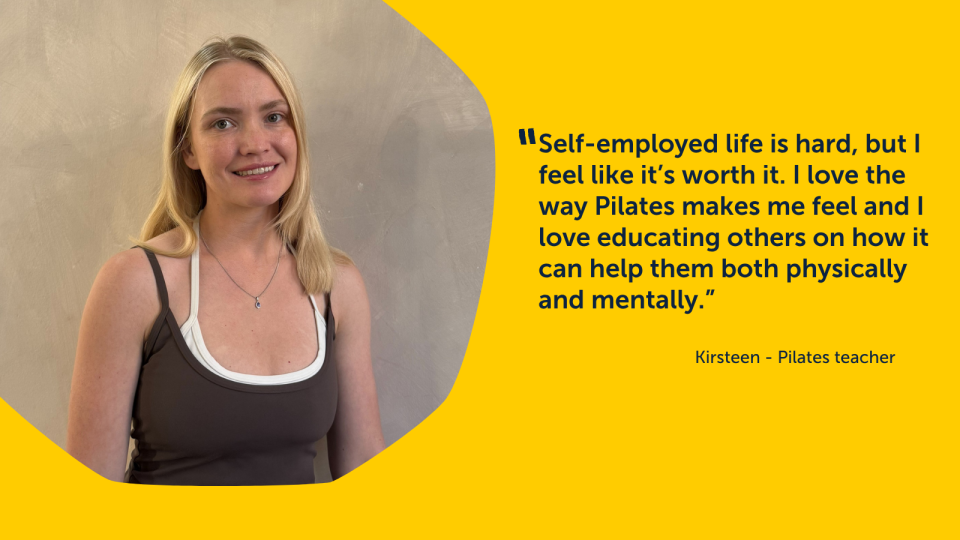
We spoke to Kirsteen about the difficulties of choosing a career, experiencing burnout and finding a passion that could become full-time work.
Choosing what to do after school
“When I was in high school, I was quite determined I wasn’t going to go to university. In Scotland, most degrees are four years, and they’re three in England. I thought, I’m not wasting four years of my life studying.” Kirsteen explained that the predicted life expectancy had a big impact on that decision and left her without a plan.
She got an offer to study childcare and after six months realised she didn’t want to work in childcare, and got a part-time job. “I then decided I loved photography, so I went and applied to college to study photography for a year. And during that time, again, I realised I didn’t want a career, I didn’t want to waste my life.”
Instead, Kirsteen decided she wanted to go travelling. “I booked a one-way flight out of Scotland for the week after my 20th birthday. I went travelling for six months, which turned into three and a half years. She saw America, Asia, Australia and New Zealand until she heard that Kaftrio was becoming available back in the UK.
“I couldn’t access it because I was away. So I thought to myself, maybe it’s about time that I grow up, study something and get a career. I was volunteering at a music festival in New Zealand and I just had this light bulb moment where I thought why not just go and study events management?”
Looking at her experiences, she realised she had lots of experience in creating and organising fundraising events for the Cystic Fibrosis Trust and the Butterfly Trust. Her parents had always done events too, and it was something Kirsteen had helped with, without thinking about it, through her teen years too.
“I looked at events management in Scotland, but it was four years and I just didn’t want to commit to four years. So I decided to study with the Events Academy in London which had a 9-month Degree-Alternative Postgraduate Diploma”
Kirsteen moved to London to study the nine month long course, but six weeks later, the pandemic began and the course went online. Kirsteen’s parents lived in Australia and everything in the UK started to shut down. “I thought: I don’t have an income, I can’t pay the rent. So I used my savings to book a flight for the next day to Australia thinking I’d be able to do my full course online from out there. It was very late nights, but it was the right decision because in Queensland, they only had a four week lockdown as they had closed the borders so I was very lucky to not experience the full lockdown the UK had.”
A short trip turned into 11 months due to the pandemic and Kirsteen was able to sort an online appointment with her CF clinic in Glasgow, and the team told Kirsteen that Kaftrio was now available and if she wanted to start it once home, just to let them know. A month later, flights were back up and running from Brisbane to Scotland, so Kirsteen moved back to begin the process to start Kaftrio.
Starting a careerKirsteen managed to get a three month volunteer role for online events and then finally landed a part-time job in Edinburgh as an Events Officer. It was a big company where she got a lot of varied event experience, but had to do a lot of work because the team was so small. After 6 months, she was offered a full-time position.
“I was quite lucky because my boss was friends with a girl with CF in high school. So straight away she knew if I needed a sick day or an afternoon off for hospital appointments, it was fine. No questions asked. I also worked from home a lot when it was admin based days, but then I’d be on site during all events.”
“When it was event season, the job could get quite physically demanding with constant packing and unpacking vans, transporting equipment and the set-up and dismantle of events. There was a few times I’d be absolutely exhausted and just mentally drained as I get quite bad fatigue with my CF.”
Three years into the job, Kirsteen then became a mum. While on maternity leaves, she decided to do her Pilates training. She loved attending classes and found that it helped her keep moving her body during pregnancy, so she wanted to learn more about Pilates and eventually share that passion with other people, particularly mums-to-be.
It wasn’t until she returned to work and started experiencing burnout from looking after a child and working on so many events, that she seriously thought about becoming a Pilates teacher.
Starting self-employment“I was quite lucky because I had already done my Pilates training, so when I started thinking about what I could do differently for work to fit around my daughter, I decided to explore teaching”
Kirsteen then started teaching a pre and postnatal baby class just once a week, on top of work but found this was all a bit much too. Kirsteen then spoke to the Work Forwards team at the Trust, as well as her parents (who are both self-employed) for advice, and decided to try teaching Pilates full-time.
“There’s pros and cons to being self-employed. I’ve got so much time on my hands and I’m not getting any burnout. Even though it’s stressful in terms of income and not knowing what your wage is going to be every month, I have so much more time to focus on myself and being a mum. Self-employed life is hard, but I feel like it’s worth it.”
Advice for othersShe acknowledged that having self-employed parents to offer advice about taxes, and a partner who is also supportive has definitely helped. “I think it’s definitely harder for someone who is single or doesn’t have that support.” It also depends on your financial commitments like rent and a mortgage.
“I went to a conference a while ago and attended a talk by a woman who advised to “stop standing on the cliff looking out to opportunities, just jump and take the risk”. So many people don’t, and you need to go for it. I think it depends on your personality as well, because I’m the type of person that I thought “if this really doesn’t work out, I’ll go to the café around the corner and ask if they’ve got shifts. I’m quite happy and open to making it work.”
She went on, “I also needed the mentality to think, if I quit my job and I jump and I go for it, I'm going to have all the time and all the energy to properly put into it, which I couldn't do with the full-time events job.”
But Kirsteen says, “you have to stay strong. People with cystic fibrosis are already mentally strong because of how much we’ve been through. So if I’m ever having a bad day, I remind myself of everything I’ve already overcome. CF has taught me that I’m capable of getting through difficult things, and that gives me the confidence to keep going when things feel hard.”
“If I was to go back to my teenage self and say, ‘you’re working in the fitness industry when you’re older’, I would have said, ‘not a chance’. I felt as if I had to fit a kind of certain type of persona to be an instructor. But I've realised that just being myself and letting my personality shine through is probably the best.”
She also thinks Pilates has given her a whole new level of confidence. “I just go in and I can hold the room, which a year or two ago, I would have never done.” Kirsteen even ran a Cystic Fibrosis awareness week in the studio, getting flags and donation buckets for the Trust, and putting these on display. “It’s given me the confidence to speak about my CF and put myself out there more.”
“The best advice is about trusting yourself and knowing that you know what you’re talking about. I have put the work and the study in, and it helps if you can find something you are passionate about. I love the way Pilates makes me feel and I love educating others on how it can help them both physically and mentally.”
“If you live with and manage CF, that is already so amazing. So just give a career a try! If it doesn’t work, you can try something else.”
-
Louie - Environmental Scientist
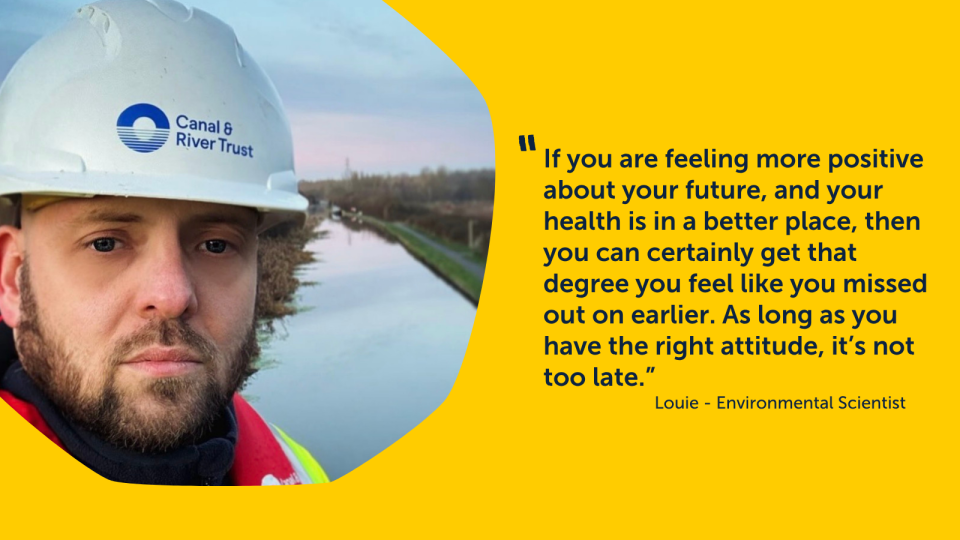
Louie is an Environmental Scientist for the Canal and River Trust and enjoys his job because of how supportive they have been over his cystic fibrosis, and the great work-life balance the job offers him.
Louie didn’t feel held back by CF in school, and though he did quite well in his GCSEs, he didn’t really know what he wanted to do going forward.
Figuring out what to study
“My dad said; well, you like geography and things like that, and you know, in your lifetime, environmental issues are going to become a really big thing, so why don’t you look at those kinds of options for sixth form. So, I ended up doing environmental science, geography and chemistry.”
Louie got accepted into Manchester Metropolitan University, with an option of studying abroad for a year. “It was a bit of a rude awakening for me, as a person with CF, having come from a really well-supported childhood where I had no responsibility or pressure on myself. It was a bit of a shock living on my own and being an adult, having to do everything myself. My treatment regime suffered with that. I wasn’t doing it as well as I would be at home.”
Louie found himself losing weight when studying abroad, and his health suffered. He had to go to hospital after getting back to the UK, but it was a valuable lesson in learning to manage his own health.
Life after undergrad
Louie did a Master’s degree in Environmental Impact Assessment and Management and also completed a professional qualification alongside that. He also began looking for work experience to bolster his CV. He explained; “I contacted a small consultancy asking if I could get some work experience over that year. I was doing a couple of days a week with them over a few months.”
This led to his first job, for a small consultancy that focused on the water industry, where he worked for four years. Though he worked for a number of well-known clients, he found out that consultancy work was not quite right for him.
Louie explained, “I found it quite a competitive, pushy environment. There was a lot of pressure to make sure that all the time I was working, I was able to charge those hours to the client.”
Finding the right fit
“I was looking for other jobs and saw an opportunity at the Canal and River Trust. They are a charity, looking after over 2000 miles of canals and rivers in England and Wales.” He’s now worked for the Canal and River Trust for 12 years. He’s found the workplace a much better fit. He explained, “It’s a more open and friendly environment.” Now Louie works in the environment team where he looks at water quality, waste and land contamination, works out what is causing the pollution, and tries to prevent it from happening again.
Louie’s work is a mix of desk work, meetings with colleagues, and getting out and doing fieldwork. As a child, he was never allowed to do kayaking, and sometimes worried about digging around in soil, and the risk to his health. He said “I have the right PPE, follow safe systems of work and don’t expose myself to any unnecessary risks. I don’t think there is anything to worry about. It’s just always something to be mindful about.”
CF and working life
“Obviously, the main ways that CF has impacted my work over the years is if I’m unwell. It’s a bit different to other people – someone might have a cold for a few days and then they’re back in work. If I become unwell, sometimes that can lead to a hospital admission, and you could be out of action for two or three weeks.”
When speaking about whether CF has ever held him back, Louie said that before Kaftrio his health was declining rapidly, and he was in hospital every nine months. He also said, physically, when heavy equipment is needed for fieldwork, his colleagues are very good at carrying this for him.
He continued, “but generally it’s probably stopped me pushing myself to get further up the ladder, take on management responsibility, or work long hours because I’m aware that I need to have work-life balance.”
What advice would you have for someone trying to get into your field of work?
Louie feels his work experience helped him when landing his first job. He said “volunteering with local environmental groups is a good way to gain experience. You can get that on your CV and it shows you’ve got the commitment and the drive to get into the sector”
He also explained that you don’t necessarily need to have lots of qualifications as there are apprenticeships and roles at the Canal and River Trust providing practical work experience that can bridge those gaps. And you can always go back and do a degree if that’s what you want.
“If you are feeling more positive about your future, and your health is in a better place, then you can certainly get that degree you feel like you missed out on earlier. As long as you have the right attitude, it’s not too late.”
-
James - Freelance Creative
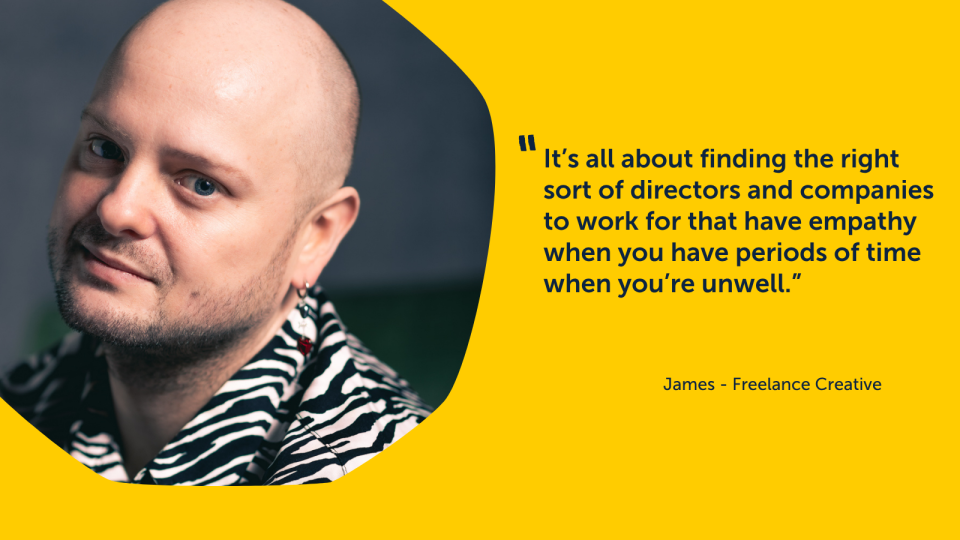 James is a Freelance Creative, who studied Performing Arts at university. He’s spent a number of years doing a variety of performing arts working, including circus and puppetry, and has recently written a play inspired by his experiences of having an invisible condition. The Power of Invisibility is on as part of the Fresh Ink Hull Playwriting Festival from 18-19 July 2026.
Health and education
Cystic fibrosis was a key part of James’s childhood – not just living it, but spending weekends fundraising. He said, “A lot of my core memories as a child involve some kind of fundraising for Cystic Fibrosis Trust. I was diagnosed when I was six weeks old and my mum was branch secretary for our region. So we would always be going to fundraisers or picking up and oversized cheque.”
Academically, CF made school quite difficult, balancing health and schoolwork. “I was good at drama and that was kind of it. I scraped through my GCSEs and then in year 11 I spent most of my time in hospital.”
James ended up getting pneumonia which led to a collapsed lung. While they were investigating, James was ill for a very long time and ended up being in hospital on the day of his 16th birthday, which was also supposed to be the day he did his drama GCSE.
“I couldn’t do it, and I just felt robbed, like that was chance to flex and perform. I had written a show and was in it, and suddenly I couldn’t do it and I was trapped in my little room on the children’s ward. I felt too old to be on that children’s ward as a 16 year old, but I had a really good team around me and they helped combat that frustration and loneliness.”
After the disappointment of his GCSEs, James did try A Levels but ended up dropping out of sixth form after missing so much school. James admits, “I felt like I could never catch up academically and struggled getting into the right frame of mind around education.
Despite this, he still had some key things he’d learned during his time at school. “I did English Lit and did poetry for the first time. I also felt like I had a debt to the stage, and that ended up pushing me a few years later.”
James then got a job, but realised this wasn’t the right path either. He ended up going to college to study Performing Arts. “Weirdly, It felt very academic, because it was on my terms and it was a subject that I cared about. I didn’t feel like I was constantly on the backfoot.” James then went to Manchester Metropolitan University, studying drama, before becoming ill and transferring to study at a university closer to home.
Entering the world of work
“Performing arts and theatre is a really difficult industry to get employment in. I was quite lucky. I was interested in movement and Theory to Theatre at that point and created my own work which gave me a couple of opportunities.”
James explained that there are lots of different areas to performing arts, and the more experience you can get, the better. He said, “I think it’s really important in theatre to have as many strings to your bow as possible. I’ll think, what else can I do? And maybe I will learn an instrument or a skill like stilt walking.” He did some work in physical theatre and then ended up doing a job with puppets, which he hadn’t had a lot of experience in before.
This then led to a TV pilot for a children’s puppet show, and then began working in children’s theatre, and touring all around the UK. He ended up doing this for 10 years – and has also continued what he enjoyed at school, by doing more writing and poetry.
Although he has never really been out of work, James stressed that being freelance is not easy though. “It’s a really difficult thing not having a steady job. And that’s for someone without health complications. I sometimes curse myself for being in an industry that is fickle when my health is fickle.”
He went on to explain, “It’s all about finding the right sort of directors and companies to work for that have empathy when you have periods of time when you’re unwell.” Despite this, he still has doubts about working in an unstable industry, when his health can be unstable too.
James describes CF as a bit of a superpower in the creative arts. “We can bring something other people can’t bring, and we have a deep understanding of ourselves.”
Finding a balance
“There have been a couple of really close calls with my health. One time, I was performing at a festival on the Isle of Wight when I had an episode of haemoptysis, which is something I used to have in my late teens.” James continued; “I was camping, and was in the middle of a field coughing up blood, due to perform the next day.”
James phoned his CF health team and got advice, still managing to perform the show the next day. He admits; “I didn’t put as much energy into it, I must have done it on 10% energy and then I came home and got admitted into hospital a couple of days later.”
James has found that being open about his condition works best for him, and for his employment.
“I’ve always been open and honest in any employment that I have CF, and actually not just employment, but in everyday life. Actually being open and honest and having that conversation at times where I haven’t been able to perform from being unwell, so they trust me to know my limitations. I know that when I can’t do it, I can’t and when I can, I can.”
James also struggles with kidney stones, and need opioids to manage the pain of this. Since 2009 he has passed over 120 kidney stones.
“It’s another thing I’ve always been open an honest about, and if I’m on painkillers and I’m about to perform, I’ll say that I don’t know how well the show is going to go. It comes with age and experience and knowing yourself a bit more, but I’m trusted to know what is right for me.”
James’s motto is: “work hard and rest harder”.
Using your experiences
James is currently writing a play about his own experiences living with CF. He explains; “We have an awareness other people don’t have, where we are so in tune with our bodies and what is going on.”
His play takes well-meaning messages he has received over the years from people who don’t understand CF like, “have you tried turmeric?”, which is “gold for a script.”
"Finding other people with CF in the past few years who are comics or performers has changed the game for me. Seeing interviews and blog posts that the Trust has done, reaching out on Instagram and being like: there’s another performer, this is great! I remember when I was a student, I didn’t really have anyone who I could look to, so having that has made such a difference.”
-
Tracey - Primary School Teacher
Tracey has CF and works as a primary school teacher. From a young age she knew she wanted to work with children. “I enjoy making a difference to their lives,” she says.
Education and Training
Tracey has a Bachelor of Education degree. “I worked many part-time jobs while studying, then went straight into teacher training, completing a four-year course.” For others thinking about the profession, she explains you don’t always need an education degree to begin with. “You can also enter through a postgraduate qualification.”
Her learning didn’t stop there. “I’ve completed a Masters degree and a postgraduate certificate in supporting teacher learning,” she says.
When asked to describe a typical day, Tracey shared, “every day is different. At the moment I’m covering non-class contact time, so my day is a mix of teaching different classes and supporting pupils with additional support needs.”
Balancing CF and Teaching
Balancing CF with teaching hasn’t always been easy. “Tiredness is a big factor. I’ve gradually reduced my hours to three days a week. Some things, like PE or school trips, are more difficult, but my employers have made reasonable adjustments.”
Working around children brings its own challenges too. “Avoiding infections can be hard. I’m very particular about ventilation and hand hygiene, and that’s made a difference.”
Advice to Others
Despite the obstacles, Tracey stays positive and practical. “My employers have been supportive, but it’s important to understand your condition and know what adjustments work for you.” She also speaks with pride about supporting pupils who share similar experiences. “For the first time we have a pupil with CF at the same school. We’re working together to keep both of us safe. Anything is possible!”
For anyone thinking of teaching but feeling unsure, her advice is simple: “Go for it!”
-
Claire - Financial Planner
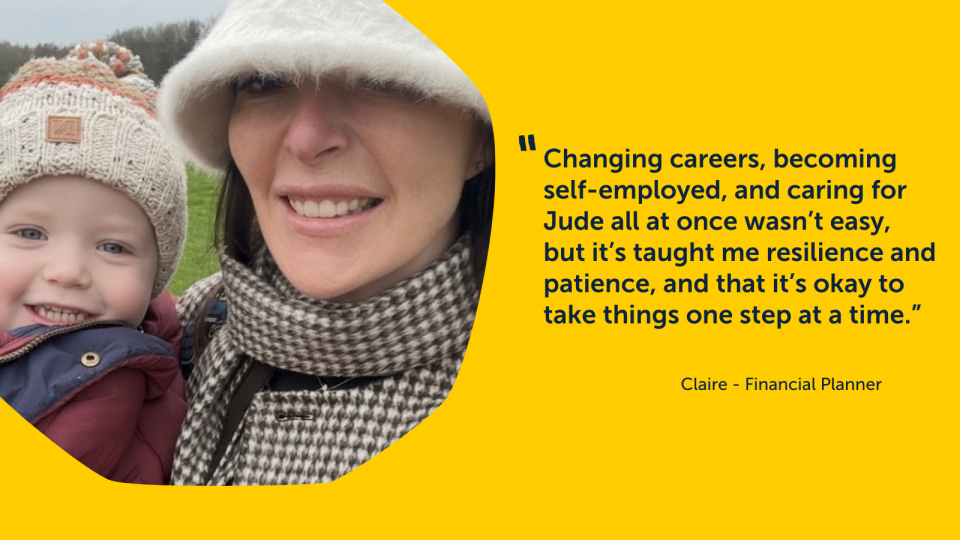
Claire is a financial planner and mum to Jude, who has CF. After spending 15 years working in property as an estate agent, she decided to completely change direction in her career. “I loved parts of it, but over time I realised I wanted something different, something that felt more meaningful and gave me more flexibility,” she says.
While pregnant, she started thinking about what kind of career would give her the freedom to build something for herself while being present for her family. That’s when she discovered financial planning. “The idea of helping people make sense of their money and plan for their future really appealed to me,” she explains. “It combined the client-focused side of my estate agency background with something that could have a real, lasting impact.”
Changing career during pregnancy
“Transitioning into self-employment in a completely new field while preparing to have a baby was a big decision, but it felt like the right time.” She began studying for her qualifications and sat her first exam at seven months pregnant. “My little boy, Jude, was born in May 2023, and just two weeks later we found out he had CF,” she says. “Four weeks after his birth, I submitted my coursework, and by the time he was five months old, I sat my final exam. I’ll never forget walking him in his pram when I got the email saying I’d passed. It was such a huge moment.”
Building her business
Now, Claire is a self-employed financial planner working in a practice. When thinking about where to work, she said, “They really understood my situation from the start. When I had my first interview, I was still on maternity leave and had Jude on my knee. They made it clear that family came first.”
She describes her job as a way to help people create a plan to get from A to B, “whatever someone’s goals are. It can include saving, investing, planning for retirement, or protection like life cover and private medical care. But it’s not just about giving advice, it’s about understanding where someone wants to be in ten years’ time, creating a plan and helping them get there.”
Claire loves the people side of her work. “It’s so rewarding to help someone reach their goals, whether that’s financial or personal. It’s not just about money, it’s about helping people feel in control.”
Balancing work and caring for Jude
Claire’s week is planned carefully around Jude’s needs. “Each day usually starts with Jude’s physio, vitamins, and modulator. Jude is full time at nursery, once I drop him off, that’s when my workday begins.”
Her week has a general routine. “Mondays are for admin and planning, then I have client meetings Tuesday to Thursday unless Jude has a clinic appointment. Fridays are for catching up on emails admin and calls . I plan my week in advance, but no two days ever look the same.”
Being self-employed gives her flexibility. “It allows me to fit work around Jude, not the other way around. Some days don’t go to plan, and that’s okay.”
She admits switching off is something she’s still learning. “Work-life balance is something I’m working on. It’s easy to let work take over, but I’m trying to be more mindful of that this year.”
Returning to work and finding support
Claire understands how daunting it can feel to return to work after having a child with CF. “Start-off or return-to-work programmes can be such a help,” she says. “It’s not always about going straight back full-time. A gradual return, maybe just a few days a week, can make a huge difference.”
She adds, “There can be a lot of anxiety around returning, so it’s important to have the right support at home and in work. Some days won’t go as planned, and that’s completely fine.”
Connecting with others has also helped. “The CF community has been such a big source of support,” she says. “People outside of it often don’t fully understand what CF involves, so talking to other parents who get it really helps.”
Advice to others
Looking back, Claire is proud of how far she’s come. “Changing careers, becoming self-employed, and caring for Jude all at once wasn’t easy,” she reflects. “But it’s taught me resilience and patience, and that it’s okay to take things one step at a time.”
She’s learned that flexibility makes all the difference. “Working in finance, especially being self-employed, means I can work around Jude’s needs. Children have needs no matter what, CF or not. A few weeks ago, he had suspected chicken pox, so I had to cancel my diary, and that’s okay because it’s on my terms.”
Her advice for others is to look for roles that offer flexibility. “Home-based or remote roles with flexible working are ideal, as they let you work in your own environment whether or not you’re self-employed.” And for anyone interested in similar work, Claire says there are lots of options. “There are plenty of roles in finance like mortgage advising or accountancy. You can work remotely, in an office, or online through Teams or Zoom, so if you’re worried about cross-infection, these tools really help.”
When it comes to looking after yourself, Claire advises that it’s the small acts of self-care that can make the big difference. “I make time to get out for a walk, even if it’s just for half an hour. Fresh air clears my head. Working from home can be isolating, so if you need support, reach out, and don’t be too hard on yourself.”
She adds, “Being a new mum as well as a mum to a baby with CF brings different anxieties, worrying about nursery, hospital stays, or how I’ll manage work. You just can’t be hard on yourself. There’ll be good days and tough days, and that’s okay."
-
Lauren - Architect
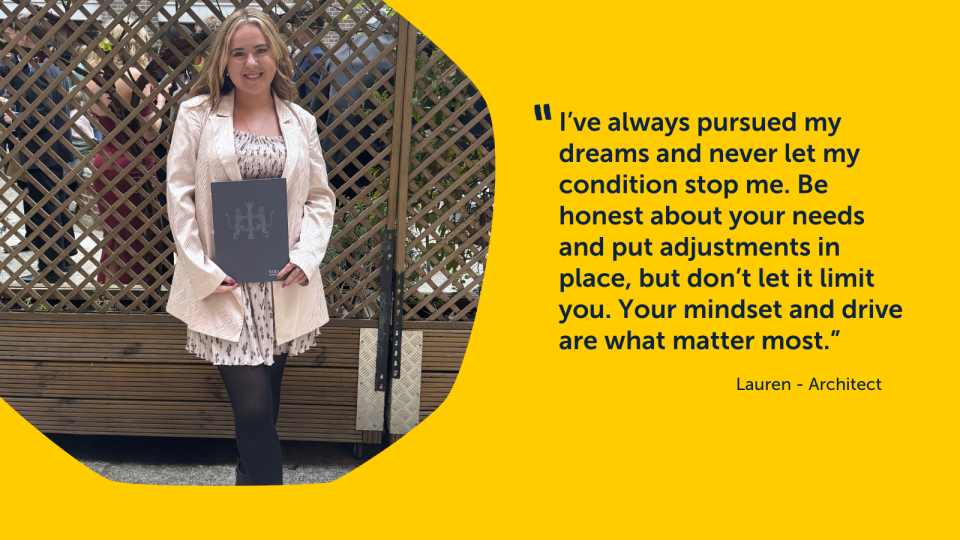
Lauren is an Architect who works at a small architectural practice specialising in master planning and residential services.
From a young age, she knew she wanted to do architecture because it combined her creativity and problem-solving. “Architecture involves a mix of disciplines including maths, physics, creative thinking, and writing reports that people might not expect,” she says. “My favourite part is definitely the design aspect: figuring out how a space will work visually and bringing ideas to life through 3D models.”Lauren studied Architecture at university. Living with CF meant she needed some extra support, but the help she got made a big difference. “The CF Trust and my team at the RVI in Newcastle were amazing. Whenever I needed time off or extra arrangements, like extended exam time, they helped by communicating directly with the university. They were a core support throughout.”
After finishing her degree, Lauren went straight into work and later completed her master’s and Part 3 part-time while still working. “I enjoyed working so much that I decided to study alongside my job. The experience I have gained since finishing my undergrad has been broad, ranging across different sectors.”
Living with CF
CF is part of Lauren’s working life. “It is naturally part of my daily routine. I have to get up and take my tablets, and at lunchtime, I need to remember to take more medication,” she explains. “Remembering to take tablets on time , especially before commuting, during meetings or when I’m out can be challenging because my memory isn’t the best!.”
Balancing her health with study and work takes careful planning. “During university, I had some hospital stays that interrupted my coursework. In my third year, I spent two weeks in hospital and had to balance recovery with catching up on my studies. Fortunately, people were understanding and made accommodations.”
Lauren even used her CF experience in her design work. “During my master’s, I designed a respiratory centre inspired by my own experiences. For my thesis, I explored how healthcare design should evolve post-COVID, comparing it to my CF journey. Bringing that personal perspective into my work gave me unique insight and made my projects stronger.”
Pathways to becoming an Architect
Lauren’s favourite part of her job is still being creative. “I love sitting down and figuring out how a space will work visually. We create 3D models to show clients what their house or building will look like, which brings ideas to life.”
She reminds people that becoming an Architect takes time and determination, but it’s worth it. “If you’re passionate about it, go for it. People are generally understanding in education and employment if you communicate clearly and have support systems in place.”
She also suggests that not everyone has to take the full architecture route. “Interior architecture focuses on the internal configuration of buildings rather than designing entire structures. Interior design is another option, and on the construction side, roles like project management or real estate involve shorter qualifications. Graphic design can also be a good choice if someone wants to stay in a creative field but avoid the full architectural route. There are lots of ways in, depending on whether you prefer design, construction, or something in between.”
Managing CF and work
Having an understanding employer makes a big difference for Lauren. “I work 5 days a week and so I have to plan my hospital appointments and medication accordingly. Communication is key. I’m honest about my condition and what I might need. Sometimes I’m not feeling up to giving 100%, and having that open dialogue helps.”
Lauren stays on top of her health by checking in with her CF team. “If I start feeling unwell, I check in with my CF team to see if I should start antibiotics. On good days, I push myself, but when I need rest, I’m upfront with my colleagues.” The hardest part is that her health can change suddenly. “Not knowing when I’ll be off or not feeling myself can be tough. A big part of my job involves planning meetings weeks in advance, so sudden changes due to health can throw things off.”
Advice to others
Lauren encourages others to be open about their needs. “Be honest from the start,” she says. “Letting employers know early about potential challenges or adjustments helps them prepare and makes things smoother if something unexpected happens.”
She also believes workplaces should learn more about CF. “Employers should educate themselves about CF, even if they don’t have personal experience. Providing training or resources to increase understanding, especially around cross-infection risks, makes a big difference.”
Lauren wants people to know that CF doesn’t have to stop you. “I’ve always pursued my dreams and never let my condition stop me. Be honest about your needs and put adjustments in place, but don’t let it limit you. Your mindset and drive are what matter most.”
-
Stephen - Business Unit Maintenance Excellence Manager
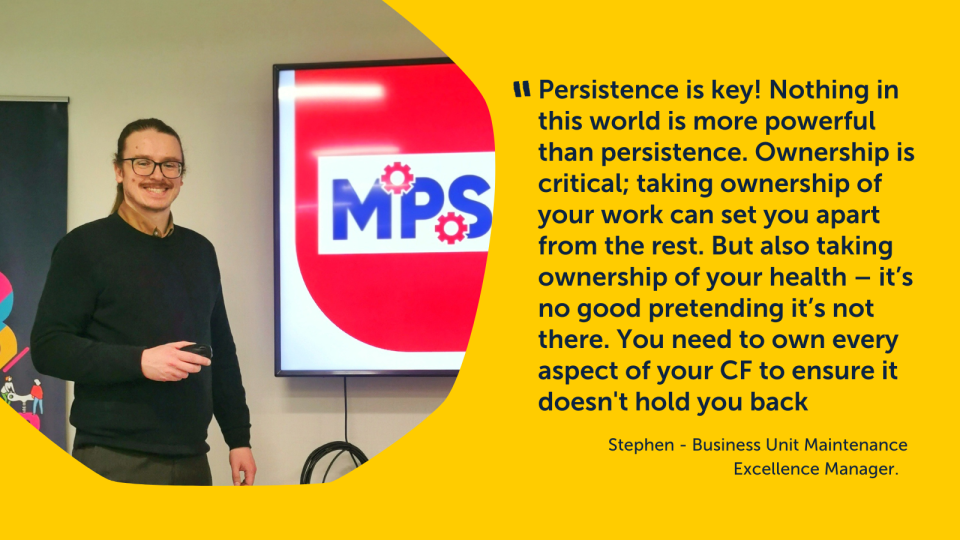
Stephen works for Müller Yogurts and Desserts as the Business Unit Maintenance Excellence Manager. He supports the central operational excellence team and coaches engineering teams across three sites.
Stephen started his career when he was 20 years old. He says, "In 2013 I started as an engineering apprentice. This involved rotating around the different parts of the factory while studying at college. In 2016 I became a fully qualified engineering technician. In 2021 I was an interim engineering manager for six months before becoming engineering team leader. Then October 2023 I started in my current role."
Advice to others about apprenticeships
Stephen recommends apprenticeships to train in lots of career areas, especially for those that are worried about university. He explains, "I would highly recommend apprenticeships in general. It was a fantastic way to learn while earning at the same time. University wouldn't have suited me for a number of reasons.”
He also shared that working for a supportive company makes such a difference. “They have always been very accommodating with my CF."
Balancing work and CF
Stephen enjoys the variety in his day to day. He says, "My job varies a lot but typically it would involve going to one of the sites, meeting with the teams there and running coaching sessions, advising them on certain aspects related to maintenance, and facilitating meetings and other work activities. I am constantly learning and meeting different people; it’s very interesting.”
Previously, his role would be much more about keeping the production machines running. “In my previous ten years in engineering, it was very hands-on and physical at times. I have always loved fixing things."
Balancing work with CF is easier in his current role. He explains, "I manage to balance work and life really well in my current job. I work from home one day a week most weeks, and due to the nature of visiting different sites, it’s quite flexible. I very much manage my own time, so it allows me to fit everything in that I need too.”
The hardest thing Stephen found was shift work. “I used to do 12-hour shifts, four on four off, with every other week on nights. I found it very difficult to get into a good routine for exercise and treatments with this shift pattern. I am very happy to be back on Monday to Friday with my current role."
For anyone thinking about next steps, he advises people to think about apprenticeships. He says, "Look into apprenticeships! The government website is really good and there could be apprenticeships out there in fields you didn't even know existed.” He suggests engineering is a fantastic field to get into. “It opens up worlds of opportunities, and I can highly recommend it if you are practically minded and enjoy fixing things.”
His overall advice is, "Persistence is key! Nothing in this world is more powerful than persistence. Ownership is critical; taking ownership of your work can set you apart from the rest. But also taking ownership of your health – it’s no good pretending it’s not there. You need to own every aspect of your CF to ensure it doesn't hold you back."
-
Siân - Reflexologist
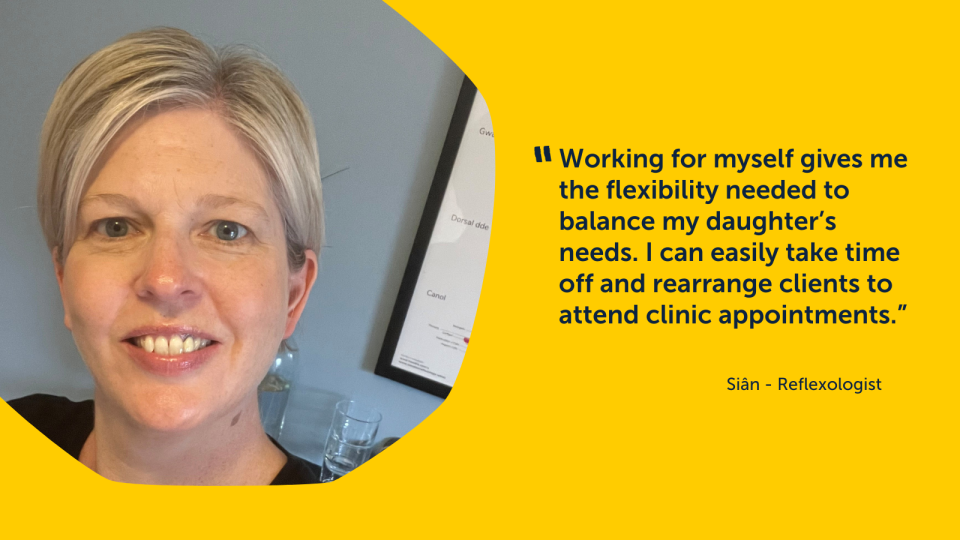
Siân is a parent to three children, one of which has CF. After working for a FE tutor for 13 years, she decided to change her career path to become a reflexologist.
For Siân, part of this was out of her hands. “I took voluntary redundancy just before my daughter’s birth and then came the diagnosis. Work was the last thing I could have coped with.”
After her daughter was born, the family moved to a rural part of Wales. With the nearest colleges an hour away, staying at home was the most practical option. She began teaching a few hours a week as a Welsh for Adults tutor but knew she wanted to retrain in a new field.
Taking a Career Change as an Adult
When her daughter was at school, Siân thought about what she wanted to do next. “I chose reflexology because I already had an interest in it. Id had reflexology treatments in the past and I was trying to think of what I can do from home.”
Siân then trained at Level 3 Diploma in Reflexology. When describing what Reflexology is she describes that it is there not to replace medicine, but to compliment it. “It works by applying pressure to places on the feet, hands, or face to promote well-being and balance within the body. I see people who are stressed, anxious, menopausal, pregnant, with musculoskeletal issues and some who are going through cancer journeys. Every pair of feet has a different story and that is what I love about it”
Reflecting on her career change, she says, “Being self-employed gives me the freedom to take time off when I need to without feeling guilty. Teaching could be stressful, as is having a child with CF, and for me, I don’t think it would’ve worked. Luckily, my husband was supportive of my decision to retrain. The added bonus is that I’m able to give my daughter reflexology and help her as well!”
Working as a Reflexologist
Siân had a less smooth start to being a Reflexologist due to COVID. “I literally only did about 6 treatments and then we were closed down for six months.”
Instead of dwelling, Siân used this time to learn how to create a website and advertise and conduct her Reflexology services from home. “The beauty about reflexology is because it also works on the hands, you can do it remotely. So during COVID we were able to run some online workshops which helped people.”
Now that Siân has a bit more of a rhythm, a typical day starts after dropping her children at school. “I sit down and go through my diary to message my clients for the following day. I then prepare my treatment room for my first clients. When they arrive, I discuss how they are before starting my treatment, which is tailored to each individual client’s needs.” She usually sees no more than four clients a day, leaving time to manage her daughter’s medical appointments.
Benefits of Working for Yourself and Parenting a Child with CF
“Working for myself gives me the flexibility needed to balance my daughter’s needs. I can easily take time off and rearrange clients to attend clinic appointments, we live an hour away from the hospital, so clinic takes a good chunk of the day!”
All her clients are aware from the start that her daughter has CF, and they are understanding if appointments need to be changed at short notice.
Siân has learned to adapt her business to her family life. “I only work school hours, which allows me to take my children to extracurricular activities and ensure that my daughter gets the active life she needs. The most difficult part is that my treatment room is in the house, so I have to make sure I clean well before and after clients so that my daughter doesn’t pick any bugs up.”
Advice to Others
For Siân, retraining was a brilliant decision. “I was nervous and apprehensive at first as being self-employed has no guaranteed income. But it is honestly the best decision I made, and at the moment, everything is working well.”
Siân’s journey has also been about balancing well-being with caregiving. “It can get overwhelming and consume you. You need to remember, if I get ill, then the whole network collapses. So set boundaries, have time to yourself, even if it’s a 15-minute walk a day or a coffee with a friend once a week.”
She also highlights the importance of organisation in managing family life. “I plan meals on a Sunday and get the Tesco or Asda delivery. When you’re scrambling to find a last-minute supper, everything goes wrong. Don’t battle through alone; get help if you can. If grandparents can pick up a child or you have a partner that can cook, take that help.”
Siân stresses that children with CF should also have normal experiences. “Don’t think they’re defined by CF. My daughter does netball, hockey, swimming, and other activities. We do enjoyable things together, like sewing and crocheting, that aren’t focused on CF. Seeing her do normal things is important for my well-being too.”
Her advice to other parents considering a career change is to think about what makes you happy. “If you are thinking of retraining or changing career, make sure it works. There’s no point stressing over the training and ending up failing. You need to find something you’ve got an interest in, something you’d enjoy doing.”
-
Simon - Data Analyst
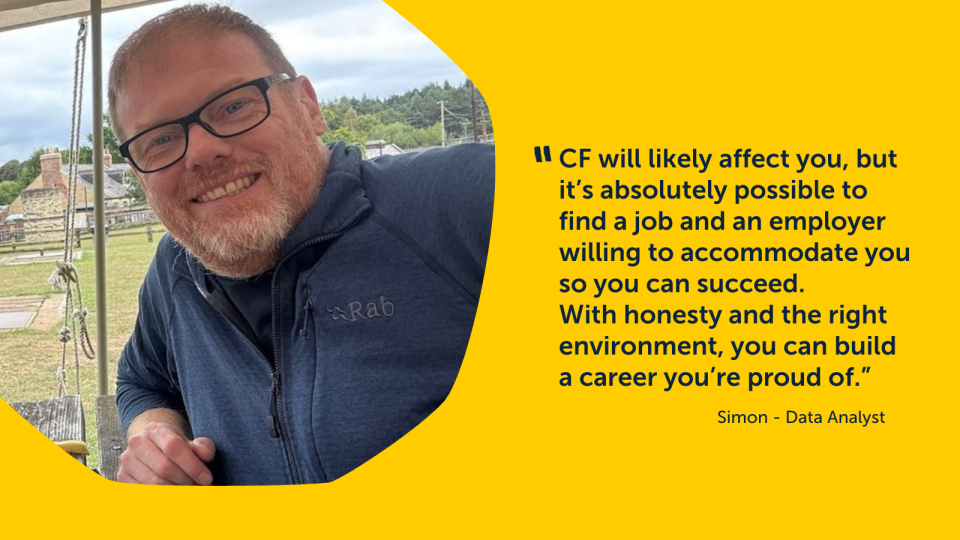
Simon has Cystic Fibrosis (CF) and works as a Data Analyst. He has worked at different organisations but for the last 12 years has been at an arms length public sector body, specialising in measuring organisational strategy and tracking the impact of funding on society.A Degree That Took Eight Years
Simon began his journey by studying Geography at Northumbria University. At first, he wasn’t sure what career he wanted. But his health made completing his degree difficult.
“Partway through my third year, I couldn’t cope physically anymore and dropped out with permission to return later,” he recalls.
Determined to finish, Simon returned after surgery and setbacks. “Eventually I went back and graduated.”
His approach the second time around was different. “The first time, I tried to be normal and keep up socially, which didn’t work. The second time, I focused on myself and accepted having CF.”
Those years were tough. “From the age of 13 to 25, I was pretty depressed the whole time. I just couldn’t come to terms with having CF.”
When thinking about what helped Simon, he reflects: “I can’t really give advice on how to change because, for me, it was just one random morning. I woke up after an argument with a friend and thought, this is ridiculous, this isn’t what life should be like. Whatever it was that day, I just chose to do something differently.”
That shift had a huge impact. “I changed my outlook on life and I got a lot more positive. I was still ill, but I found that a lot of my health issues actually improved when my mental health improved.”
A Varied Career Path
Simon tried different jobs before moving into data analysis.
“I started job hunting just before the 2008 financial crash. A family friend gave me a job doing IT work in a small engineering company, which I did part time while also receiving disability benefits. I worked there until 2009 when, due to the economic crisis, I was laid off.”
He then worked supporting disabled people into employment. “They picked me from a list because I had been open about my own experience with disability during the application process and wanted someone with lived experience. This was an extremely rewarding job, but unfortunately it was only a temporary contract.”
After more short-term work, Simon got a full-time administrative role at his current organisation in 2012. “As it happens, my experience of juggling around six different casual jobs at the same time was the key skill they liked during my interview, as the admin role I got was really quite intense and demanding.”
Moving into Data Analytics
Simon was later encouraged to apply for a new role in Data Analytics. “I had no real experience, but I applied during a restructure. I’ve received lots of training and am now experienced using modern tools like Microsoft PowerBI for analysing data and presenting results.”
A typical day can vary. “These days I mainly work from home, so I roll out of bed, get a coffee, and log into work. Some days I work completely independently, processing data, designing dashboards, or setting up reports. Others can be wall-to-wall meetings, either with my team or colleagues across the organisation. Almost all meetings are on Teams, although we do get together in the office now and again.”
When thinking about his favourite parts of the job, he says “It is when I get to put my Geography degree to some use. If I could, I would spend all my time working with environmental data.”
Advice for Others Considering Data Analytics
Simon believes the Data Analytics field is open to many backgrounds. “The core skills are IT literacy since you’ll spend your life using software. Most people enter with a decent understanding of spreadsheets and then get further training in Power BI or programming languages. Being organised, detail-oriented, and patient helps. Managing a complex condition like CF proved surprisingly good experience for the role”
A degree can help but isn’t essential. “Most people probably do have one because many organisations require it, but apprenticeships are a great route for people without degrees. I did a Geography degree without much stats or IT background and still got into the field.”
Benefits of Working in the Public Sector
Simon has found working for a Public Sector organisation a much better fit than private sector jobs. “It was quite a culture shock compared to small engineering firms because they were extremely supportive and flexible when it came to working with my disability, for things such as medical appointments or working around being on IVs. I was even given time off to attend clinical trials.”
He recommends public sector roles in general. “These jobs offer flexibility and work-life balance, which suits me better than private sector roles that demand long hours and high pressure. I’m happy to take less pay for better health and stability.”
He particularly highlights government employment. “Government employers tend to be ahead on equality, diversity, and inclusion. Pension benefits are also important since I may retire early due to CF.”
Protecting Yourself at Work
Simon stresses the importance of legal protections. “It’s important to protect yourself legally by registering your disability with your employer, even if uncomfortable, so you have protections under the law. Joining a union can also provide support.”
He encourages openness. “Don’t be scared to declare your CF to your employer, and try to realise what skills a lifetime of managing a complex medical condition can bring you in an employment situation.”
He also suggests joining employee networks. “If your employer has groups for things like disabilities, don’t hesitate to join them. They offer a great support network, and are a great way to use your lived experience to help others and yourself improve where you work.”
Final Thoughts
Simon knows that CF can make careers challenging, but he’s clear about what’s possible.
“CF will likely affect you, but it’s absolutely possible to find a job and an employer willing to accommodate you so you can succeed. With honesty and the right environment, you can build a career you’re proud of.”
-
Cavan - Managing Director
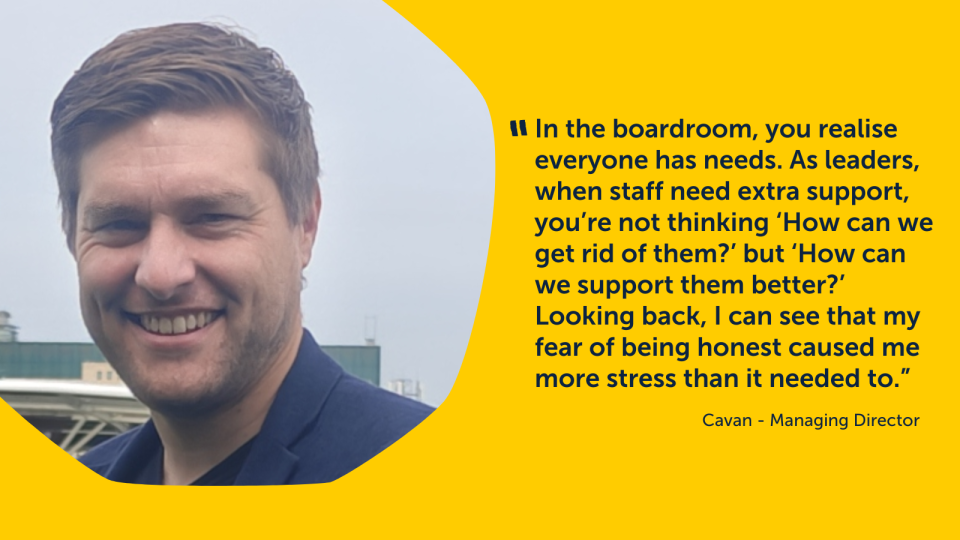
Cavan works in cybersecurity and is now Managing Director of an independent risk and security consultancy. Along the way, he has navigated the challenges of living and working with CF.Growing Up with CF
At school, Cavan found it hard to manage his health alongside studies. He remembers his GCSEs and A levels as “very average,” but he had already discovered his love of computers. “I started making my own computers when I was a child. I had my own little eBay business way back when, and I thought… I want to get into this.”
That passion took him to Birmingham City University to study computer networks and security. University was a turning point. “It’s at that point where I started to really pay attention to my CF. I was suffering quite a bit… and the penny dropped. You’re paying for university, so you need your health to make the most of that investment.”
Starting Out in Work
Cavan graduated with a placement year and a first-class degree. “I was really chuffed with that.” His first job was at a small company where he felt able to be open. “These guys made me feel a lot more comfortable that I could be quite open about cystic fibrosis.”
Still, he feared being judged. “I didn’t want people to think, don’t promote him because he’ll be a liability if he gets sick.” Despite this, the company supported him, even when he needed to go into hospital or take time off.
Later, moving to a bigger company, he kept quiet at first. “I started in software configuration, then became a project manager, then a business analyst. But despite progressing, I found it hard to be honest.” After a year, he asked for space to do treatments. “They said, ‘Absolutely, you can use that meeting room.’ From then on, I could openly do treatments and there was no judgement. What held me back was my own thinking.”
Growing into Leadership
Cavan’s career grew quickly. He was headhunted by a global firm and gained his first experience in cybersecurity risk. “As technology improved, I started delivering more and more from home, which gave me balance.”
He later moved into consulting, became Chief Technology Officer, and eventually achieved his goal of becoming Managing Director. “That was a career goal I’d had from the start, wanting to see if I could run a company.”
Being in leadership gave him perspective. "In the boardroom, you realise everyone has needs. As leaders, when staff need extra support, you’re not thinking ‘How can we get rid of them?’ but ‘How can we support them better?’ Looking back, I can see that my fear of being honest caused me more stress than it needed to.”
Living and Working with CF
Balancing CF with the demands of a senior role is a constant challenge for Cavan. “One day you wake up knackered but you’ve got an important client pitch. Or you pick up a cold that turns into a chest infection. You want to take time off, but you don’t want to let people down.” Over time, he’s learned that the key lies in communication and trust. Rather than telling everyone, he focuses on a few colleagues who can step in when needed: “Have a few key people who understand your condition and can support you.”
He stresses the importance of listening to your body and being honest about limits. “Sometimes your body screams that you need a break. It comes back to communicating in the right way about what you’re going to need.” When it comes to talking to managers, he suggests “I think most managers genuinely care. They want to get you back to work as quickly as possible without breaking you again. So approaching conversations with honesty and seeing your manager as someone who wants to help can make a big difference.”
For Cavan, living with CF has also built a sense of perspective. “If I’ve overcome what I have with CF, most other challenges seem small and insignificant.”
Routes into Tech and Cybersecurity
Cavan highlights that tech is expansive. “Software engineers, project managers, business analysts, sales, marketing, there are many routes in, and some are very remote-friendly.”
He says experience counts most, but certifications also help. “CISSP, CISM, vendor-specific ones from Cisco or Palo Alto. There are thousands of applications in cybersecurity, so certifications for leading platforms complement skills and experience.”
However Cavan feels passion is the most important thing. “In interviews, the biggest thing that sets candidates apart isn’t just technical skill or certifications. it’s their attitude and passion for the role. Bringing your authentic self and showing genuine enthusiasm can often outweigh gaps in experience because attitude drives long-term success.”
Advice for People with CF
Cavan’s advice is to keep it simple with employers. “Early on, I over-explained my condition. Now I’d say: explain the challenge, show you want to work together on adjustments, and emphasise you want to stay well and productive.”
For those starting out in tech, he suggests trying out different areas. “Cybersecurity is huge, you can go technical or broad, move sideways, explore. Find what you enjoy.”
And for interviews: “Attitude sets people apart more than technical skill. Passion and desire to deliver value matter. Bring your authentic self. Try to enjoy the process despite stress and nerves.”
Cavan’s final advice is to be open with your employer. “It took me around 18 years of experience to finally realise and validate for myself that the notion I had, that coming clean about cystic fibrosis would hold me back in my career. was just not true. Being open about my condition has helped me get support rather than judgement, and that has made a huge difference.”
-
Willow - Freelance Animator
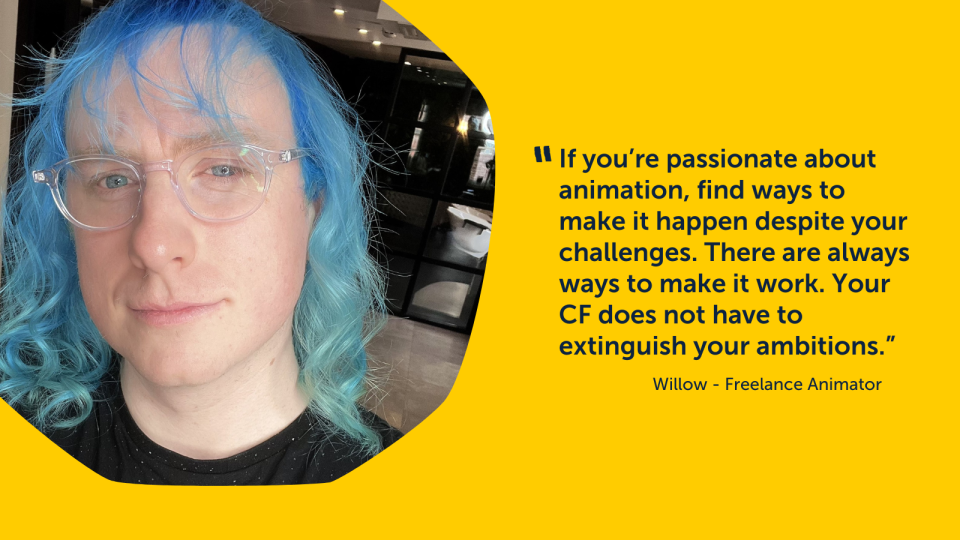
Willow is an award-winning freelance animator and designer who has worked with major clients such as the BBC, the BRIT Awards, and LEGO.
Their journey into animation started early. They shared, “My first paid project was around 2010 when I was 15, designing a book cover for a friend’s novel,” At Birmingham City University they studied Visual Communication specialising in film and animation, Willow combined academic projects with professional work. “My university even had a marking section rewarding industry work done outside the course, so I got credit for those client projects as much as for my university projects.” This approach helped Willow build a strong portfolio and professional experience before graduating.
One of Willow’s biggest early opportunities came during university, when they were selected for a project that turned out to be for the opening sequence of the BRIT Awards 2016. “I didn’t realise it was for the BRITs. They purposely withheld that detail to avoid attracting people for the wrong reasons,” Willow explained. “I was involved throughout the process: experiments at the university, filming in London with dancers and Ant & Dec, editing, and setting up LED screens at the O2 arranged like a zoetrope.” Being at the O2 also meant seeing rehearsals from artists including Adele, James Bay, and Jess Glynne, an experience that remains one of Willow’s career highlights.
After university, Willow joined Ember Television in Birmingham. But the adjustment to a full-time office routine took a toll on their health. “I ended up in hospital for IV treatment, likely due to being rundown from adjusting to a full-time Monday-to-Friday schedule for the first time in my life.” That hospital stay marked a turning point. “After hospital in April 2017, I decided to go fully freelance. And I’ve been freelance ever since. Freelance work gives me freedom that working a 9–5 couldn’t.”
Realities of the Industry and Freelancing
“Being freelance means I control my schedule. I start work only after completing my physio and morning routine, unlike having to fit my routine around a fixed office start time. This routine is now second nature and doesn’t feel like a burden.”
Having strong support within the industry also helps Willow manage CF day to day. “Sometimes, especially after events like conferences, I notice the impact of CF on my energy levels,” they said. “But the creative community is supportive, often offering quiet rooms for de-stressing or providing name badges with pronouns, which helps create an inclusive atmosphere.”
Willow is open about both the highs and lows of freelance life. “The biggest pro is freedom, to set my own schedule and choose my work. I can start whenever I’m ready and reschedule if needed, which is especially important given my health history. Cons include the pressure to constantly source new work and advertise my skills. There are times when I feel uncertain about future projects, which can be stressful, especially when saving for things like a house.”
Willow shared that feeling able to be transparent with clients can be an important part of freelancing. “During a difficult period in October 2020, I was honest with a client about needing to stop a project temporarily. He was very understanding, which helped immensely. Working directly with individuals rather than large companies tends to foster better understanding and flexibility.”
Advice to Others About CF
Willow shared the importance of feeling comfortable to share CF with others. “Before starting university, I declared my health condition and was assigned a contact in student support. I received helpful material support like a MacBook upgraded for my animation work, a dictaphone, ergonomic equipment, and a scanner,” they explained.
“Four days after moving in, I found out I had Pseudomonas and had to adjust my schedule to include nebulizer treatments and tablets. My parents dropped off the nebulizer kit without staying, helping me maintain independence.” Despite being hospitalised a few months into their first year, Willow received support and was determined to continue. “I kept up with work remotely, even collaborating on group projects despite being in hospital. I earned a first for that project and maintained top grades throughout university.”
Willow shares that balancing health and creativity has required discipline but also self-compassion. They encourage others to not feel they have to stick to the conventional career pathway “Your path might look different, but that doesn’t mean it’s less valid. There will be ways to fit your health needs around your ambitions. I’ve learned that being honest about what you need, whether it’s flexibility, time off, or remote options, often leads to better understanding and stronger working relationships.”
Advice to Get Into Animation
For those hoping to follow a similar path, Willow believes passion and persistence matter more than any one route into the industry. “You can definitely learn animation skills without university. It’s not just about technical skills but about storytelling, character development, writing, and explaining complex ideas simply.”
Willow taught themselves many of their tools using online tutorials and platforms such as Envato Tuts+, Video Copilot, Mograph Mentor, and Motion Design School. When asking Willow what the best way into the industry is, they share “Some courses are free, others paid but cheaper than university. Passion and love for animation are crucial, without that fire, skills alone aren’t enough.”
They encourage aspiring animators with CF to explore the variety of roles available. “Animation careers vary widely, and there will be a way to fit your CF with what you want to do. Some types of animation, like stop motion, may be more physically demanding, but many roles involve desk-based computer work.”
Willow’s advice for people unsure whether a career in animation is for them is, “Go for it 100%. Don’t let CF put out that fire. Even if your path looks different from others’, you can create a version of being an animator that works for you. If you’re passionate about animation, find ways to make it happen despite your challenges. There are always ways to make it work. Your CF does not have to extinguish your ambitions.”
-
Lucy - Freelance Journalist
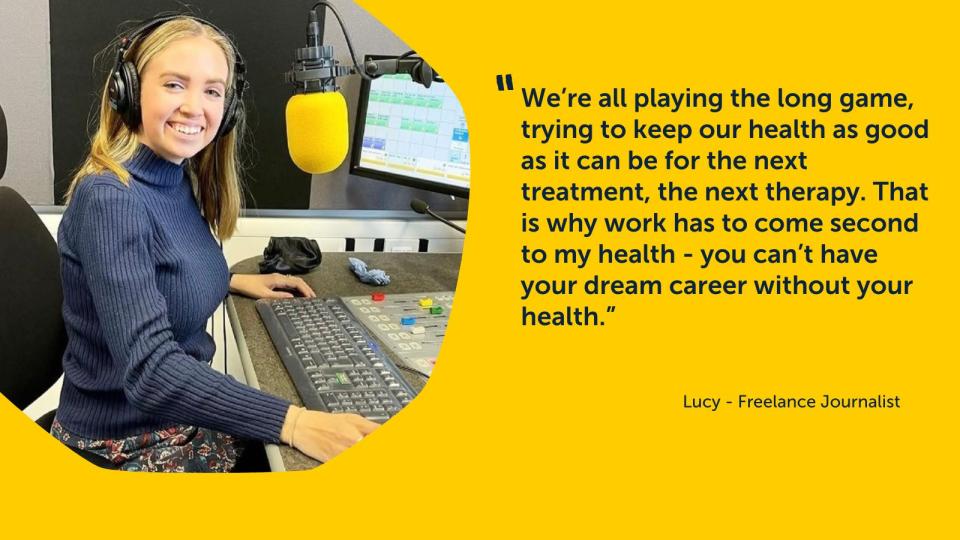
Lucy is a freelance journalist working on a range of creative projects in the broadcast sector, from BBC News, UCB Radio and different podcasts. She loves talking to people, putting them at ease, and telling stories that matter. But her path into journalism wasn’t always clear.
Finding her Path
“I didn’t really know what I wanted to do when I was at school,” she says. “But I knew I wanted it to be linked with communicating and talking to people.”
At college, she explored different university courses but struggled to commit. “I just couldn’t sit down and write the personal statement… because I didn’t know why I wanted to do it.”
A visit to Liverpool University sparked something for her, and she went on to study Communication and Media there.
Early Experience
During her course, Lucy did work experience at BBC Breakfast. This was an early taste of where she would later end up.
After graduating, Lucy completed a Masters in Broadcast Journalism in Salford during the pandemic. It was a challenging time to get experience, so she had to think creatively. She set up her own podcast, ‘From a Lancashire Lass’, interviewing local businesses, celebrities, and people from her home county. She also freelanced in local radio once restrictions eased.
Three years on, Lucy has worked across radio, newspapers, and now national TV.
Living and Working with Cystic Fibrosis
Living with CF means Lucy sometimes needs to take time off work or adapt how she works.
“When I had a two-week course of IVs, I actually needed the rest and the boost… I spent those two weeks doing paint by numbers, switched off, and didn’t watch the news. I just needed that break.”
She also credits her CF team for helping her adapt. “When I started this job, I talked through my shifts with them, and the physios suggested maybe doing a quicker type of physio in the morning and a longer one in the evening… That kind of planning saves me time and energy.”
Lucy has become more comfortable with the idea that work at times has to come second to her health. “I learnt that I am replaceable at work and someone else can always pick up my stories if I am not working if I am unwell, but to be me, I need to be healthy and no one can replace me as a person. So I try to do my best, drink lots of water, carry healthy snacks, and let myself slow down if I need to.”
Advice for Others
For those interested in creative careers, Lucy shares practical tips:
“If you want to work in TV, start making little YouTube videos. You don’t even need to publish them anywhere but having that portfolio and gaining experience builds your confidence and skills. If you like radio, use your phone’s voice memo app to create little packages, or write blogs online.”
She is also open about her health at work and encourages others to be the same. “CF is a registered disability. Especially if you’re employed, use that to your advantage. Speak openly with HR and your managers. Being open about it has helped me a lot.”
When it comes to thinking about our futures, Lucy shared "We’re all playing the long game, trying to keep our health as good as it can be for the next treatment, the next therapy. That is why work has to come second to my health - you can’t have your dream career without your health."
-
Jon - Police Sergeant
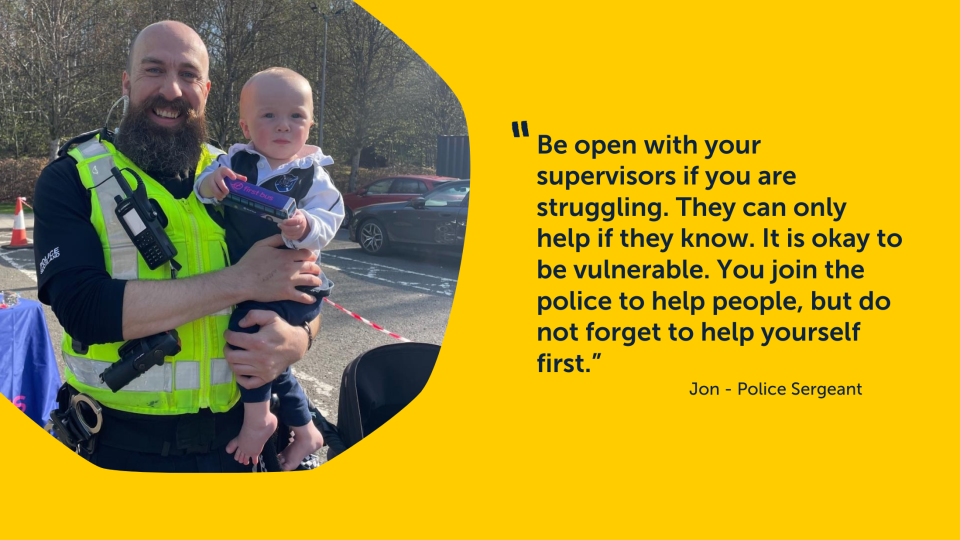
Jon is a police sergeant and a dad to baby George, who has CF.
Journey into the Police
Jon joined the police at 18, straight after finishing his education. “It was rare to be accepted that young back then,” he recalls. “They liked you to have been around the block a few times.”
When he joined in 2001, the entry requirements were GCSEs and a couple of A-Levels. “It has changed a lot since then,” Jon says. “Now there is a much bigger academic focus, rather than one that values life experience.”
Policing has been Jon’s only job. He was promoted to Sergeant in 2013 and still loves his work. “It gives me the chance to help people, both in the community and in the office. In 22 years, I have never had the same call twice. I like not knowing what will happen each time I lace up my boots.”
A Day in the Life
“No two days are the same,” Jon explains. "As a frontline officer you deal with everything, from crime to social issues like the impact of addiction and poor mental health. Every time you leave the office you are managing risk, often making instant decisions with very little information.
“It can be uncomfortable sometimes. We are all human, and none of us join to do a bad job. We have families we want to get home to, so we try to treat the community how we would want our own family treated. But ultimately, we are the thin blue line that runs towards what everyone else runs from. That takes resilience.”
Becoming a Parent to a Child with CF
Jon moved to Scotland in 2020 and met his partner, Amy. “We moved in together, and about 18 months later, Amy fell pregnant. It was fantastic news.”
Their son George was born in January 2024. Jon shared, “from that moment, he has been everything to us. It is me, Amy, George, and our little dog, Oliver.”
However, finding out George had CF was a tough period for Amy and Jon. “You expect to enjoy your newborn, but our start was very different, traumatic for all three of us. We had to learn what any new parents would, while also managing hospital visits, the diagnosis, and caring for a vulnerable baby.”
Having supportive managers made all the difference. “Early on, they said, 'Whatever you need, you have got it.’”
Managing Work and Being a Parent
A month before George was born, Jon had been offered a new Monday to Friday role, 7 a.m. to 3 p.m., instead of shifts. “Looking back, it was serendipity. It meant I could be home every evening and weekend, vital for George’s extra needs and for us as a family.”
The change to Jon’s work pattern allowed him to help with physio and medications every evening. His employer has given him special leave for hospital appointments, a laptop for home working, and has never refused a request for time off or flexibility. “I cannot fault them. They provided practical and emotional support, regular check-ins, and genuine compassion.”
Advice to Parents of Children with CF Wanting to Join the Police
Jon loves being a police sergeant but appreciates shifts can be challenging. “Most people join as a constable on response shifts, earlies, lates, nights. That is a big adjustment for a CF parent unless you are used to shifts. Probation is demanding, long, unpredictable hours and constant assessment.”
“One option is the Special Constabulary, which is voluntary, with shorter training and flexible shifts, so you can try the role first. There are also many civilian positions with more predictable hours, like 999 call handling or civilian investigator roles.”
“If you are determined to be a constable, difficult does not mean impossible. After probation, you can move into specialisms and shape your hours more.”
Jon says CF parenting adds value to policing. “It has given me perspective and empathy. Last year, I supported a father whose child has CF. I could speak his language straight away.”
Advice to Parents Returning to Work After Having a Child with CF
To feel confident returning to work after having a child, Jon suggests sharing as much as possible. “Be open with your employer, and do it early, months ahead if possible, so they can make adjustments. My partner Amy also works for the police. She spoke to her manager six months before returning, and they found her a non-public-facing role to reduce infection risk and support breastfeeding.”
Jon emphasises the importance of knowing your rights, as large organisations may not always make all available resources clear. He advises seeking out internal networks, such as disability or carers groups, and not being embarrassed to ask for assistance. While this effort can be demanding, Jon suggests that providing employers with information to help them understand CF can be very beneficial for securing necessary support, noting, “CF is rare, so you might need to educate your managers.”
Jon shared that, initially, it can feel lonely. “At the beginning, it really does feel like you are alone in this, but you are not. Use the community, the CF Trust and Scottish CF charities have been brilliant. It gets better. You learn to live with it, not around it. Hang tough.”
Finally, Jon offers a crucial piece of advice: “Be open with your supervisors if you are struggling. They can only help if they know. It is okay to be vulnerable. You join the police to help people, but do not forget to help yourself first.”
-
Helen - Animator and Business Owner
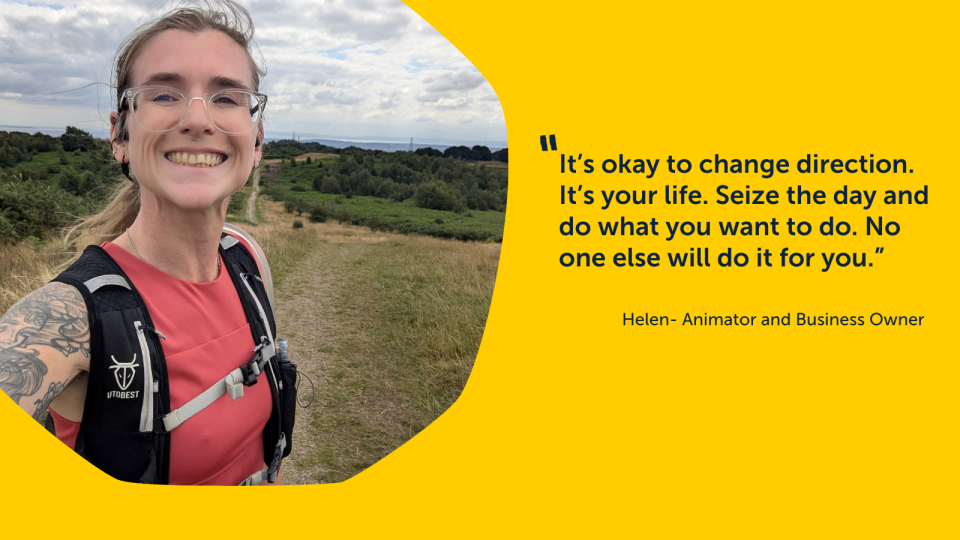
Helen is an illustrator and animator who co-founded Boundless Studio, a creative animation company in Cardiff, with her partner, a 3D artist. She also lives with CF.
Early Path into the Arts
Her journey into the arts wasn’t a straight line. Straight after school, Helen took a foundation year in art, which led to a degree in Illustration. But after graduating, she found it hard to make money from her creative work. “To be honest, I just needed an income,” she says. Her first job was in a local chip shop, and she ended up spending a few years in hospitality.
Alongside this, Helen volunteered for a mental health charity, which sparked an interest in social care. She went on to work in a café, supporting disabled people into work, before moving into work within supported accommodation. “I’d kind of accepted that this was my direction in life,” she says.
A Pause During the Pandemic
Then the pandemic hit. Furloughed for nearly nine months, Helen says, “It gave me an unexpected pause to rethink my path. I thought, ‘What am I going to do?’ Drawing had always been a quiet passion, I always had little sketchbooks, watercolours, little moments of creativity.” Her partner encouraged her to return to it properly. “He kept saying, it’s just a matter of time and dedication, eventually you’ll get there.”
That push helped Helen rebuild her career. She got her first job in animation as a designer and junior at a studio, and from there, things grew. Animation quickly became the right fit. “Despite the technical challenges, I found real joy in it, especially when it connected with others.”
One of Helen’s proudest moments so far has been ‘Peredur’s Journey’, a bilingual immersive animation project inspired by Welsh fairy tales. “Watching children react to our film honestly brought a tear to my eye,” she says. “People just looking around, playing, enjoying it, it was absolutely beautiful.”
The film, which was shown on four walls with surround sound, combined 3D characters with hand-drawn 2D environments and motion graphics. It was also the first major project from Boundless Studio, which Helen and her partner launched. “I realised that’s why I love being creative,” Helen says. “It’s not just about the corporate stuff. It’s about sharing something that makes people feel something.”
Living and Working with CF
Helen is open about the realities of living with CF while working in a demanding field. “I’ve always kind of bullied myself and thought, ‘Don’t be left behind.’ But it’s all in my head, and actually what I’m doing is enough.” Over time, she’s learned how important it is to listen to her body and take time to rest when needed. “If you’re not feeling 100%, take that time. It’s only you you’re answering to at the end of the day.”
Balancing health with work is a constant juggle. Helen splits her time between agency work and running her own business, which can be intense. “Sometimes you just have to get it done, then rest later,” she says. “If you’re not feeling well, maybe don’t go to that massive event.” For Helen, learning to set boundaries has been essential.
Advice for Others
Her advice to others, especially people with CF who are unsure about their career path, is to take your time and follow what feels right. “Not everyone knows what they want when they’re young. It’s okay to change direction. It’s your life. Seize the day and do what you want to do. No one else will do it for you.”
And for those wanting to get into animation, she adds: “While self-teaching is possible, having guidance helps a lot because animation involves many technical nuances best learned with feedback. To grow creatively, stay curious, practise regularly, and seek guidance through courses or mentors.”
Helen’s journey hasn’t always been straightforward, but she’s found a way to bring together her passions and build a career that works for her. “I’ve had hundreds of no’s. It’s not personal, it’s just competition,” she says. “Just keep going.”
-
Gemma - Self-Employed Social Worker and Play Therapist
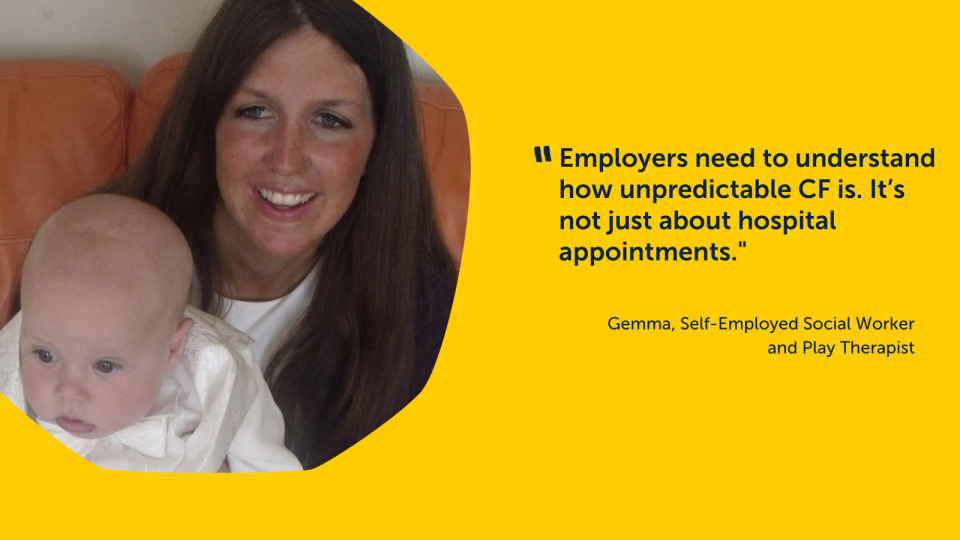
Gemma is a self-employed Social Worker and Play Therapist. Over the years, she’s worked in different areas within these sectors including fostering and safeguarding. But when her fourth child Blake, 12, and later her fifth Leo, who was recently born, were both diagnosed with Cystic Fibrosis (CF), her career path needed some changes.“The first diagnosis came completely out of the blue. We already had three healthy daughters, so it was a real shock. I knew nothing about CF at the time. It felt incredibly isolating.”
Caring became the priority
At first, Gemma couldn’t imagine working again. There was a grieving process and the emotional toll of having a child with CF that felt overwhelming. “With my older son, I couldn't see a way forward. I could only imagine my child was going to be suffering and I was depressed. It was hard to picture anything beyond Cystic Fibrosis and this new caring role. Over time new medicines have reassured me and I now envision a long and healthy life for my boys.”Taking the first steps back into work
Over time, things began to shift. She slowly started thinking about work again, paying the mortgage became the priority. "The usual financial pressure is still there, for example you want family holidays more than ever with a child who is often poorly. To start with it was not full time. I started by picking up freelance hours through old contacts from my training. Just a few sessions at a time. As well as money it gave me a role outside of being a parent and carer.”That first step made a huge difference. “It helped me feel like ‘myself’ again. Not just ‘the CF mum’. I love my family and being a mum always comes first, but I actually enjoyed turning off from CF worries and having a role that was rewarding.”
Self-employment and flexibility
Self-employment gave Gemma the freedom to work on her own terms, and to step back when family needed to come first. “When my son is ill or in hospital, I can just stop. I don’t have to explain or justify myself to anyone. That kind of flexibility is really important to me.”
Years later, when her youngest child was also diagnosed with CF, Gemma had already found a rhythm that worked for her family. “I wouldn’t go back to a rigid full-time job at the moment. Local authorities and big organisations don’t offer the kind of freedom I need. Smaller charities, or working for myself, are a much better fit.”
Despite the challenges, she’s built a life and career that work side by side. But it hasn’t come without sacrifice. “It’s a constant juggle. I often work late at night and weekends to catch up. But it means I’m there when my kids need me.”
Advice for other parents
She wants other parents and carers going through something similar to know there’s no one right way to return to work. “If work isn’t possible right now, that’s okay. You haven’t failed. When and if you're ready, even just a few hours a week can help you get back on your feet.”She also encourages people to be honest with themselves about what they want. “Everyone’s different. Some parents aren’t able to go back to work straight away, and that’s totally fine. If you do start thinking about it, try writing down what would be ideal for you. Like, ‘I can only work part-time,’ or ‘I want mornings only.’ Then look for jobs that fit that. Your priorities might change, and that’s okay too. The main thing is to put your family first and work out what balance works best.”
Finding connection through community
Staying connected with other parents of children with CF has helped Gemma feel less alone. “I’m in a WhatsApp group with other CF mums who work. We share everything from hospital tips to job interviews. Just having someone else say, ‘me too’ or ‘have you tried this?’, can make such a difference.”
What employers need to understand
She also wants workplaces to better understand the hidden labour involved in caring for someone with CF. “Employers need to understand how unpredictable CF is. It’s not just about hospital appointments, it’s the day-to-day treatments, the mental load, the constant planning.”
And it’s not just practicalities. “You’re always holding your breath, waiting for the next infection, the next hospital stay. That’s draining in itself. So I’ve learned to advocate for myself too.”
Making it work, on her own terms
Gemma’s career journey hasn’t followed a straight line. But by staying flexible and being creative with work opportunities, she’s made it work. “You don’t have to follow the ‘normal’ path. You just have to find what works for you and your family. It’s not always easy, but it is possible.” -
Evann - Retail Assistant
Evann has been working as a retail assistant for around 12 years. She works part-time on a zero-hour contract and says that the flexibility this gives her has been key to managing life with CF.
Her day-to-day work is varied. It includes everything from accepting deliveries and working on the shop floor to occasionally helping managers with end-of-day cashing up. It’s a job she knows well and generally enjoys, but it can be physically demanding.
Managing Work and CF
“The most difficult part is how physical the job is when my CF isn't the best. I'm always on my feet and up and down stairs constantly so I definitely feel it when I'm not feeling my best.”
Evann says that the unpredictability of her condition makes the flexibility of zero-hour contracts really valuable. While some people might struggle with not having fixed hours, she finds it’s a good fit for her needs.
“I’ve not learned to plan or manage it a particular way as my shifts change each week. It does help though if I’m not feeling great, because there’s not a set amount of hours I need to do. If I needed to do a week with less hours I could just mention that to a manager and they will sort it for me.”
When her health takes a dip, she knows she can take a step back from work without too much worry. “The only time I’ve had to take a break from work is when my chest is pretty bad and I need to go into hospital for IV antibiotics. When I find out I need to be admitted I just let them know and they’ll take me off the rota. They wait for me to get back in touch when I’m ready. Usually I’m off for like 3–4 weeks.”
Adjustments and Support at Work
Although Evann doesn’t currently have any formal workplace adjustments in place, she feels confident that her employer would be supportive if anything changed.
What’s helped most, she says, is having honest conversations with her managers and colleagues about her health. She’s always been open about her CF, and encourages questions when they come up.
“Most of the people I work with know all about my CF. They know how it affects me and all the different things I have to do to keep well. They ask how appointments went and if I think I’m going to need to go in for IVs or not.”
“I think what makes those conversations go well is the fact I let them ask whatever they want about CF. Or we just have a general conversation about appointments I have coming up and they learn more about it. For example, recently I had a diabetic eye screening appointment and was chatting with a manager about it – from that he learned about CF-related diabetes.”
The Best Parts of Working in Retail
When asked what makes a good team, especially when you’re managing a health condition like CF, Evann doesn’t hesitate.
“The people I work with are the best part about my job. My now best friend is someone I met there over 10 years ago. If they see I’m struggling with my chest, they’ll offer to do more physical parts of the job for me. Like helping a customer get something that needs the ladders out or getting heavy boxes down in the back for me.”
Retail work can come with particularly hectic periods, especially around Christmas and the back-to-school season in August. For Evann, it’s about powering through and planning short breaks to keep herself going.
“Christmas and August summer holidays are the two busiest times in retail. These are when I get the most hours, which can be tiring. I don’t really have any tips to help – I just get on with it and get through it the best I can. Having a few days booked off here and there throughout the month helps, just having something to look forward to.”
Advice to others considering Retail
For anyone with CF who’s considering a retail role but feeling unsure, Evann recommends easing in gently to test the waters.
“I would say try it out and start with small evening shifts or the odd weekend day and see how it goes from there. Some days a little three-hour shift could be really calm and quiet, other times it could be non-stop. But you’ll get to see how you cope with the physical aspect that comes with it.”
“Start doing smaller shifts like three-hour ones on a zero-hour contract and just see how you go from there really. It does also help with keeping active. And finding managers that understand it all makes it so much easier.”
-
Ian - Tech CEO
Ian is a tech CEO with CF and has spent over 25 years in the tech industry. His career has involved building software, microchips, cameras, medical devices, telecommunications systems and developing online safety software used by police forces.
His interest in technology started young. “From the age of about 10, I was fascinated by electronic and computer things,” he says. By 14, Ian had an amateur radio licence and was building radios and antennas. That passion led him to study computer science and electronics at Edinburgh University, where he was already exploring ways to apply tech in creative settings. “I did lighting for clubs like Cream and Ministry of Sound when visited Edinburgh. I did sound for big theatre shows. I’ve always been tinkering with technology and making it useful in the real world.”
Building a Career in Tech
Ian’s first job was with a university designing image sensors. “We were working with a lot of the big US tech companies,” he recalls. “I spent time at the Intel Mattel Smart Toy Lab working on some of the first digital toys. Things like a Barbie-branded camera and a microscope for educational use.”
Later, he worked on a Vodafone project developing early prototypes of mobile payment technology, which eventually gave rise to of M-Pesa, the mobile payment system that revolutionised online payments in parts of Africa. And more recently, Ian co-founded Cycomb, a company that builds tools to help police identify child abuse and terrorist content more quickly. “It’s about 100 times faster than anything else out there,” he says. “It means frontline staff can check a laptop or phone there and then, instead of waiting up to 18 months for lab results. That has helped to rescue children who have been trafficked. It’s probably the thing in my career I’m most proud to have contributed to.”
Living with CF as a CEO
Unlike most, Ian didn’t learn he had cystic fibrosis until his 40s. He had a long history of chest infections and had several rounds of investigations to find out why after more serious episodes but didn’t explain why until genetic testing became available.
“Most of the time there is virtually no impact on my work, which is great,” he says. “I try to be open about my condition with key people around me so that when I do need adjustments or time off, it’s not out of the blue.”
The biggest challenge, he explains, is managing medical appointments, whether routine visits to the CF clinic or extra check-ups during an exacerbation. “My work calendar is always full, so I’m constantly rearranging things to keep time free.”
While Ian is usually well enough to work, the less visible symptoms, such as fatigue or side effects from treatment, can be harder for others to understand. “If I’ve got a really nasty cough, colleagues are sympathetic. But people don’t always get how much more effort it takes to keep up during periods of fatigue. I might appear symptom-free, but it’s exhausting.”
He adds, “There’s a lot of extra faff that takes effort they don’t see or understand. Whether it’s arranging time off, explaining why I’m not quite on top of things, or just explaining why I seem less enthusiastic than usual, it all takes energy.”
Ian believes in being open with employers and colleagues when it feels safe and appropriate. “I often hear people worry that talking about medical conditions will make them seem weak. But I’ve been fortunate to work in supportive environments where openness is met with understanding and accommodation.”
Advice for Young People wanting to get into tech
Ian is full of encouragement for young people with CF who are interested in tech. “There are a huge number of different opportunities,” he says. “A degree helps for technical roles, but it’s not the only way in. We have people in marketing, customer success, and sales. You can build your knowledge using free online resources.”
Ian feels tech is a good industry to be in if you have CF. “If you have to disappear for a hospital appointment or do your physio, usually nobody’s even going to notice. The world of tech is generally populated by really nice and progressive people. It’s very often a flexible environment. Most of my engineering team and customer success team work home based probably 9 days out of 10. It’s generally a very inclusive environment.”
To help find out the right area, he suggests using AI tools to find recommended courses or tutorials. “It’s a great way to get a quick overview of a new topic.”
For those looking to move into leadership roles, Ian stresses the importance of preparation. “People often get promoted without support. Just when they’ve got good at writing code, we expect them to manage people. It’s sink or swim,” he says. “Think about what leadership actually involves. What are the gaps in your skills? Can you find a mentor who’ll give you honest feedback?”
Ian’s final advice on getting into tech is to remember that “Tech isn’t one thing,” he says. “There are so many sectors and opportunities. Stay curious, combine passion with purpose, and don’t be afraid to ask for help along the way.”
-
Michael - Fundraising
Michael left education with very few qualifications after CF impacted his attendance at school whilst studying his GCSEs.
“I have very few GCSEs. I was unwell for most of Year 10 and Year 11. I tried to do some A-Levels, but failed miserably.”
Michael felt that he had missed so much during his GCSEs that he was now too far behind to catch up.
“Education, wasn’t for me. I was just never going to be an academic.”
Michael was struggling to find a career he enjoyed. He had always enjoyed fundraising for the CF Trust, so Michael decided to see if he could pursue his passion for helping others as a career choice.
“Having fundraised for my whole life for the CF Trust in different ways, whether that was charity football matches, running the London Marathon and skydiving. I wanted to get involved more deeply in the sector and continue fundraising.”Michael’s lack of qualifications weren’t seen as a massive barrier in the industry. He began volunteering at a national children’s charity and whilst networking at an event, he found out about an unpaid internship at another charity. Michael was faced with the difficult decision of figuring out if he should quit his well-paid sales job to take up this volunteer opportunity.
“For someone who was in a paid job, who had a mortgage and was also planning a wedding, it was a pretty bold step.”
For Michael, it felt like the right thing to do, to pursue a career that really appealed to him. The risk paid off, and after a successful interview, Michael began supporting the fundraising team at a big national charity.
“It was just about being there, being open, being willing to try and do anything, asking loads of questions and just hoping that something came up.
Within a couple of weeks of starting his internship, the charity had offered Michael a paid admin role within the same team. Michael now had his foot on the first rung of the career ladder in the charity sector. Thirteen years later and after a number of different roles at different charities, Michael feels he has found a career he loves. He is now a Head of Fundraising for a national homelessness charity and manages a team of fundraisers.
“To fundraise and fill some of those gaps for people across our society, that need it so much, is an honour and a privilege.”
Michael believes volunteering is a great way to get into working in the charity sector and can be the start to a successful and fulfilling career.
“See what kind of charities you are interested in. Find their volunteering opportunities and start getting your name involved with as many different charities as you have time for. Learn the sort of things that might be of interest to you, and then start speaking to people across the sector. You can start at the most junior role and work your way up to CEO. There's a number of CEOs who have started as volunteers at charities and worked their way up to the top.”
-
Jess - Hospice Worker
Jess is a sibling support worker at a children's hospice and provides essential emotional support for the siblings of children who are receiving hospice care. “Most of this support comes in the form of play, and so I spend my days at the hospice doing arts and crafts, playing in soft play, practicing TikTok dance routines, or playing football.”
Jess enjoys getting to have fun and being silly with the children, but she also provides siblings with a safe space to process their emotions at an incredibly difficult time. As well as play, she also runs ongoing bereavement support groups for children whose sibling have died. Sometimes Jess will visit children out in the community (either at their school or their home) to provide counselling and emotional support, ensuring that the children can continue to access much needed support post-bereavement.
Prior to finding this role, Jess had done some Youth Theatre work, as well as some freelance projects, before choosing to go back to university to do her Masters and become a Drama Therapist. Jess acknowledges though, that having a Masters wasn’t an essential requirement for her current job role.
Each morning Jess catches up with her team to learn more about the families using the hospice. Some of the families she knows well, whilst others she will be meeting for the very first time. “I spend time with the children, getting to know them and what they enjoy doing. We all have lunch together, and then in the afternoon we pick up our games where we left off!”
The hospice provides a number of activities ranging from sports teams to visits from therapy animals, providing a huge amount of variety for the children that Jess supports. “No two days are the same, which is something I love about my job.”
Jess works four days a week which helps Jess to manage her CF. Starting at 9:30am each day also helps her with managing her treatments. The biggest challenge Jess has found, is that she is often working alongside very unwell and medically vulnerable children, and so she has to be careful that her or the children are not susceptible to the same infections. However, by working closely with the doctors, she is able to manage these risks.
-
Anthony - Palliative Medicine Doctor in the NHS
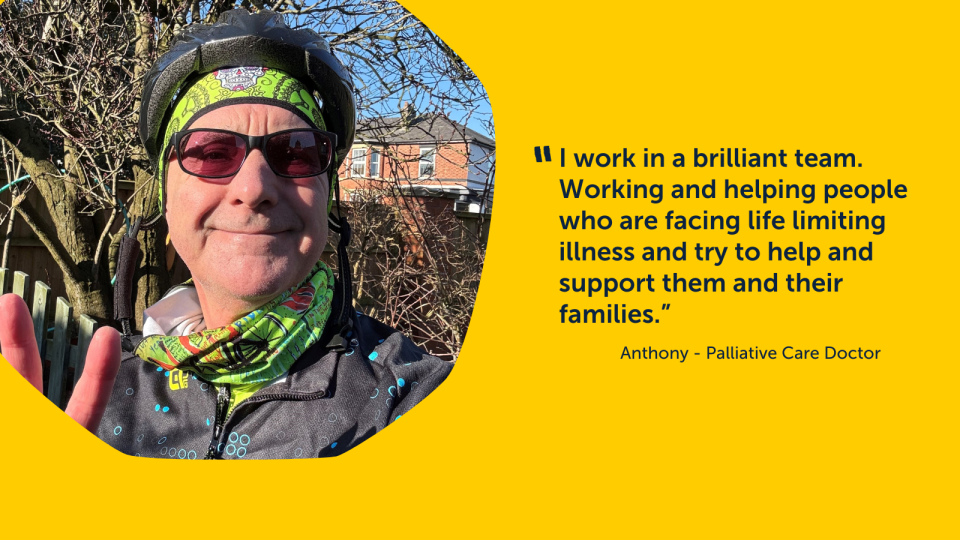
Anthony works as a Doctor in Palliative Medicine in a hospital-based role for the NHS. He really finds the work fascinating and this sees him often "working and helping people who are facing life limiting illness and try to help and support them and their families". Prior to moving into Palliative Care, Anthony worked as a GP for a few years. Anthony’s journey into his current role involved going through medical school, undertaking postgrad training and exams. The majority of his time is spent doing patient reviews, working in outpatient clinics, attending meetings and getting involved with strategic plans.
In regard to balancing his work and CF, Anthony says it can be hard. He tells us that he may be prone to certain infections and find that wearing a mask is helpful in trying to avoid catching germs. His advice to others from his personal experience is to always be honest about their health. Despite the challenges, Anthony still has a lot of positive things to say about his job. He works as part of a brilliant team, he finds his role rewarding and says that the insight healthcare professionals have is so helpful when dealing with people.
Anthony’s advice to people looking to follow a similar career path to his? "Go for it!"
-
Harry - Film Maker
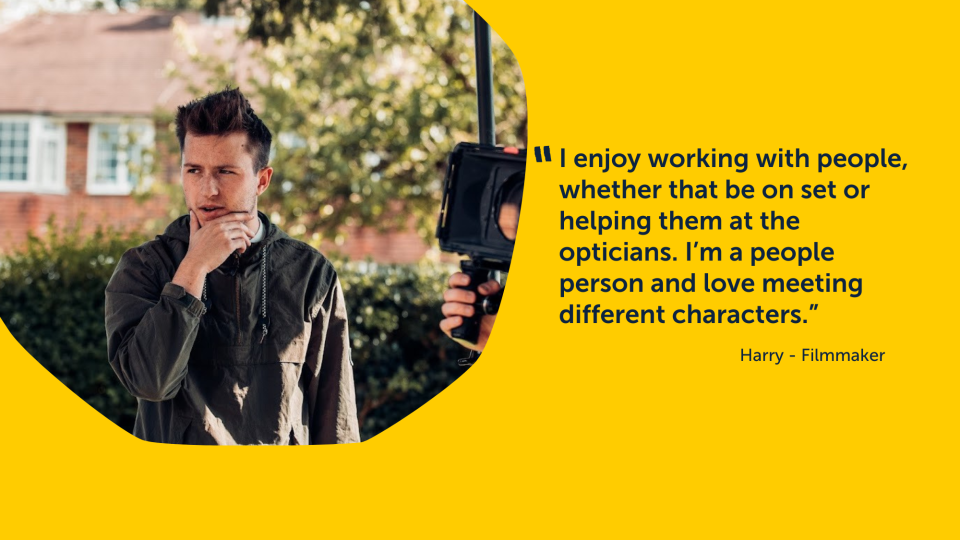
Harry studied film production at college and focused on getting as much work as he could in the sector once his course had finished. He now runs a film production company called Room 18 films. The company produces short narrative films in which he often acts, writes or directs himself. He is also employed as a store manager at Specsavers. "I enjoy working with people, whether that be on set or helping them at the opticians. I’m a people person and love meeting different characters," says Harry.Healthwise, things haven’t always been easy for Harry, but he credits Kaftrio as being important in helping him to carry on his career: “Being honest, eventually getting Kaftrio was quite literally a life saver for me. It improved my health massively, which felt like getting my dignity back," Harry told us.
"I could do the things my friends could do without trying to hide how out of my breath I may be, I could commit to things without worrying if I would be in hospital or not and obviously as I got older, most importantly, I could start thinking about work and how I would prepare for my future even though I felt frighteningly behind compared to everyone else."
Harry says he used to be quite private about his CF, and he wouldn’t always want to tell employers in case they judged him, or they didn’t hire him if he managed to get to the interview stages of a job application. "But I soon realised i shouldn’t act ashamed or embarrassed by my condition and in fact addressing face to face made me build a better more healthy relationship with my CF and in turn, how I viewed myself," Harry says.
Harry also shares his wisdom on the resilience that many people with CF have had to develop, and how he feels that resilience can help an employer: "It’s our experiences that make us unique and individuals, I think any workplace longs for a strong individual and I know people with CF have a strong enough character to stand out from the crowd.”
-
Verity - Puppet Maker
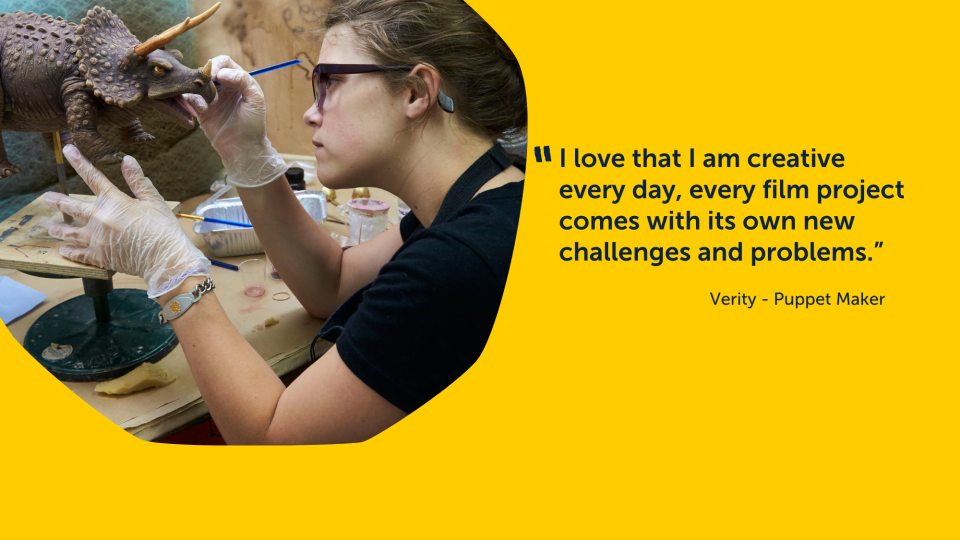
Verity is a puppet maker in the film industry and runs her own business, CreatureCave, which creates fantastic bespoke puppets for customers. She has previously worked for Aardman Animations, who are best known for creating the Wallace & Gromit films.
“I love that I am creative every day, every film project comes with its own new challenges and problems.”
Verity’s tips for people who want to consider a creative career.
“Be honest with yourself and let your creativity take over! Also a huge amount of passion about this kind of industry. Keeping fit and healthy, as the film industry can become pretty physically demanding. Make sure to network with other artists in the industry and ask lots of questions! Social media is so that you can showcase your work to a lot of people.”
-
Nicole - Retreat Owner and Yoga Teacher
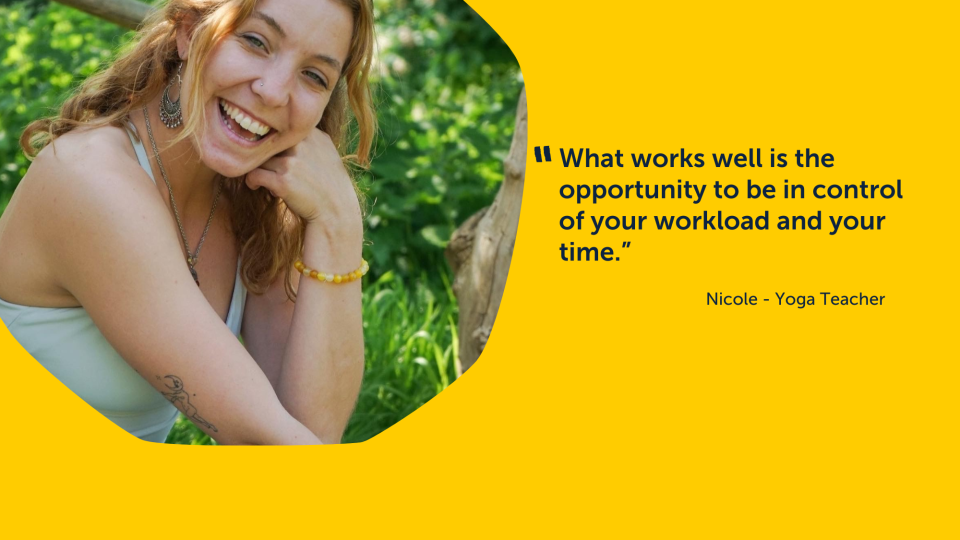
Nicole is a self-employed Yoga instructor - and former member of social media team!
She has seen the benefits that working in the fitness industry can have on managing CF.
“What works well is the opportunity to be in control of your workload and your time. Knowing what times of the day you work best is key, and allowing yourself to take time off when necessary to avoid burn-out. Building any business takes time, patience and learning along the way."
Nicole also shared her thoughts on how teaching Yoga has helped her with living with cystic fibrosis.
“I am working my lungs and body in all my classes, and have a deep understanding of my lung's capability, capacity and overall needs through developing and teaching about breathwork techniques and body awareness. Better understanding your physical body, respiratory and overall wellbeing will
bring you more in-tune with your up and downs.”
-
Josh - Military Aircraft Simulations Engineer Apprentice
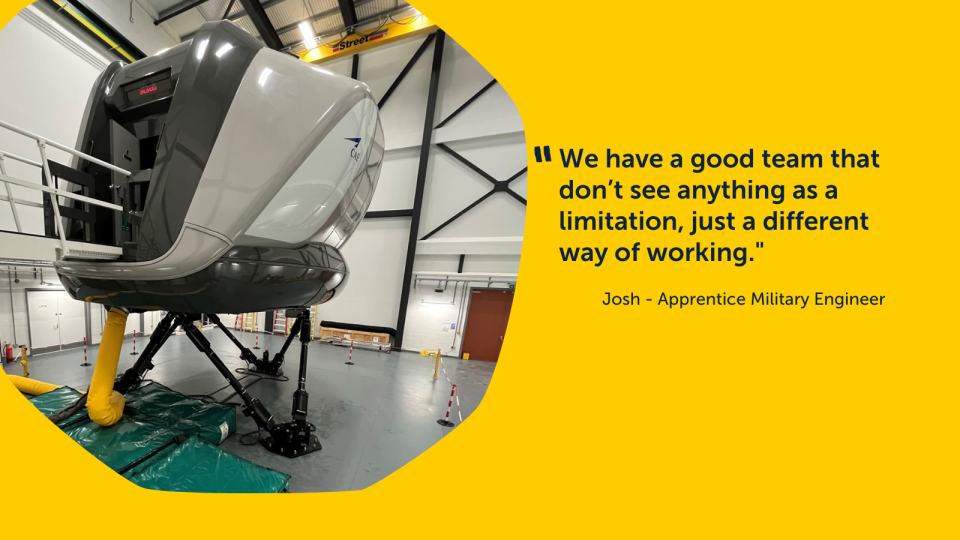
Josh is a Military Aircraft Simulations Engineer apprentice. This is Josh’s first job since leaving education and he really likes the variation of his role, as no two days are ever the same, and the people he works with, "We have a good team that don’t see anything as a limitation just a different way of working."
His role involves a range of duties throughout the working day. He spends his first hour turning on 20 devices, from full motion simulators to desktop trainers. Then there is a break until flying starts for the day. During the flying program all maintenance is reactive, so during the program he works on smaller projects or paperwork. Once flying finishes, he needs to clean the equipment and do any maintenance that is required on the devices before he turns everything off.
When it comes to managing work and CF, Josh says that his employer is very accommodating with hospital appointments. His advice for a strategy to manage work and health is not to let CF be a limitation, and he feels that cystic fibrosis is only as limiting as he allows it to be.
-
Victoria - Nail Technician
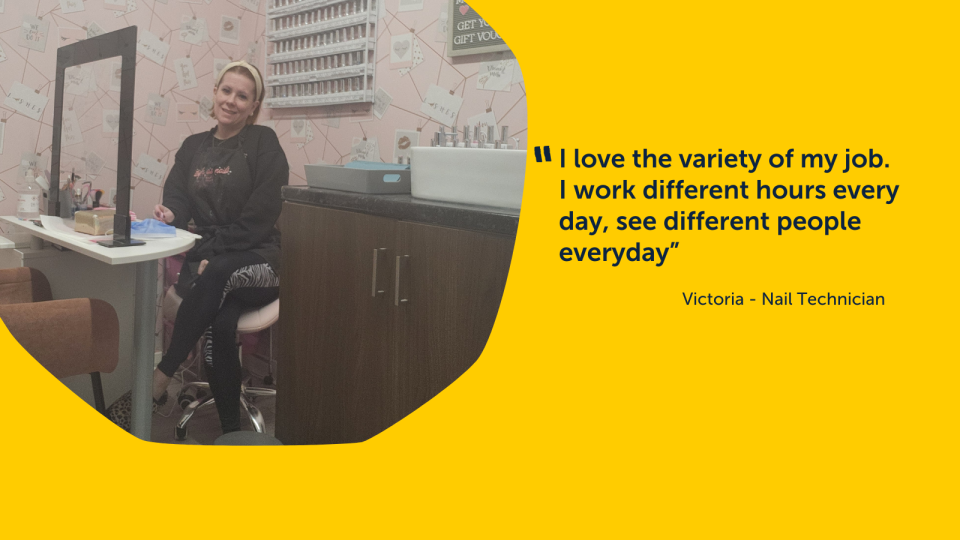
"I've always craved flexibility in my work. I think as CF and CFRD treatments can be so regimented, I never wanted a repetitive routine at work. I now have time to do all my treatments at home, and if extra treatments are needed, I can fit those in too."
Victoria, a self-employed Nail Technician tells us what she loves about her job!
"I love the variety of my job. I work different hours every day, see different people everyday. I love chatting to people all day and making people feel good about themselves.
"During lockdown, it made me realise I wouldn't like it if I couldn't work at all as my work gives me a social and creative outlet which I definitely missed when I had to close my business and shield. I am very sociable, so this part of my job keeps me sane. It’s a great way to socialise and control the number of hours you want to work."
-
Sarah - Yarn Shop Owner
The Knit Lounge, founded by Sarah, one of our previous Helen Barrett Bright Ideas award winners!
We asked her to share how things have been going so far, and what she’s looking forward to with the business in 2025.
“Earlier this year I opened my first business. An independent yarn shop focused on knitting and crochet supplies for the discerning crafter. It was such a scary and exhilarating time with doubt and excitement in equal measure.
“When I applied for the Helen Barrett award, I had already secured a small bank loan and signed a lease for a retail space. The award gave me the ability to have the front of the shop painted and to have a traditional sign painter add my logo to the shop frontage and as a mural inside behind the till. It really added a professional and beautiful finish to the shop.
“Navigating the first year in business has been a big learning curve. There are lots of areas that I want to work on but only so many hours in the day. Building a customer base and seeing people return again and again has been great!
“There have been good weeks and bad, days where it’s been incredibly busy and days where you take £3.50. Managing the cash flow of the business is very different to receiving a wage and I've found that the biggest challenge. It's something I'm getting better at and will do differently next year.
“Opening a shop during a cost of living crisis has been challenging but I wouldn’t change it! I've loved every step and only hope I can continue doing what I'm really passionate about. Next year I'm hoping to reach a wider audience with online lessons and mail order kits, offer more classes with guest tutors and I've also been trying to find some time to work on some of my own knitwear designs and patterns but its early days. The physical shop is just one arm of what I hope to be able to offer in the future. I'm hoping 2025 sees the business go from strength to strength!”
-
Charlotte - HR Manager
We spoke to Charlotte, who works as a HR Manager and told us more about her career journey!
“I first started by volunteering in a Press Office before going to university. Once I graduated, I went into Customer Service part-time and worked for a local newspaper again on a volunteering basis. I really liked this, however, the fast pace was not ideal as I was not keeping well at the time."
Charlotte explored different roles, gaining valuable skills along the way.
After transitioning into HR, she found her passion:
“I was intrigued as I know often they are not viewed most favourably, but then had a light bulb moment that I wanted to change this view. I wanted to make sure HR was seen in a positive way, someone to talk to, someone who can help. I studied whilst working on my CIPD level 5 and have worked my way to now be the HR Manager. ”
“I like telling people they have the role they applied for. I also like working alongside all different departments as you get to understand a business a lot better. From a CF viewpoint, I like the fact that I can see both sides—what it means for people to be off work and what it means when you need time off.”
Balancing work and managing CF isn’t always easy, but Charlotte has found ways to make it work:
“I work 4 days a week and am on hand on the fifth day. It does impact financially, but also allows me the time to manage my CF, which in turn means I hope not to end up sick.”
Huge thank you to Charlotte for sharing an insight into her career story so far!