Content warning: this story contains mentions of life expectancy
Adam, who has cystic fibrosis (CF), took on an incredible 13 lake swimming challenge to mark his 30th birthday. He talks about completing the challenge, raising awareness of CF, and his hopes for the future.
Our podcast host Lucy Baxter, who has cystic fibrosis herself, is recording the next season of Cystic Fibrosis Trust’s podcast, CForYourself. For each episode she’ll be writing an accompanying blog relating to the topic discussed. This month is all about celebrating #TeamCF – our community of supporters who go above and beyond to make a difference for people with CF.
Today, 16 January, Daniel Zeichner, Labour MP for Cambridge visited Professor Martin Welch’s lab at the University of Cambridge to find out more about his work to improve treatment options for lung infections in people with cystic fibrosis (CF), a life-long, life-limiting condition without a cure.
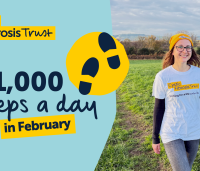
Step into February with purpose! Join Cystic Fibrosis Trust’s fundraising challenge and walk 11,000 Steps a Day in February. Register now and get your FREE t-shirt.
Since 2013 the Trust has supported over 200 early career researchers to conduct CF research. They’ve been involved in studies to develop effective treatments for everyone, to improving the management and treatment of CF symptoms and complications.
We’ve stepped inside the lab to chat to some of them. Their stories are shared below.
This study aims to investigate the effect of yoga on health-related quality of life for adults with CF. It will also assess any changes in physical health (such as strength), mental health (such as anxiety) and assess the economic cost of yoga against usual care. Participants will take part completely remotely (from home). Participants will be randomly put into two groups. One group will complete a 12-week course of specially created online yoga classes (the intervention group) and one group will continue with their usual CF care and no yoga (the control group). In the yoga group, participants will be...
An important part of a researchers’ role is writing up the results of their experiments and how they were conducted. It allows others to learn from their findings and reduces the possibility of others repeating unreported experiments. However, it can be a daunting task, particularly at the early stages of your career. Dr Rebecca (Becky) Dobra, Dr Dom Hughes and Dr Guy Moss shared their experiences and advice.